Top 7 Jira Service Management alternatives in 2026
Looking for a Jira Service Management alternative that doesn’t slow you down? If high costs, poor usability, and plugin sprawl sound familiar, this guide highlights 7 tools built for teams who need ITSM and project delivery without the headache.

Table of contents
Why teams are moving away from Jira Service Management
Jira Service Management vs Jira Service Desk
Jira Service Management alternatives
1. Easy8
2. ClickUp
3. Asana
4. Redmine
5. Zendesk
6. ServiceNow
7. Freshservice
Why Easy8 stands out among Jira Service Management alternatives
TL;DR
If Jira Service Management feels bloated, expensive, or hard to manage, this guide shows 7 smarter alternatives (like Easy8) that combine ITSM and project delivery in one platform, with lower costs, less admin, and built-in features you actually need.
Why teams are moving away from Jira Service Management
Looking to move away from Jira Service Management? You’re not alone.
Many project and IT teams voice similar frustrations about JSM's limits, especially when scaling across complex IT environments or managing post-delivery service.
You might be familiar with these pain points shared by real users:
- Unpredictable costs: Tiered features and per-agent pricing create budget uncertainty.
- Hard to set up and maintain: Admins often face steep learning curves and mounting config complexity.
- Basic reporting: Advanced insights require costly add-ons or upgrades.
- Heavy reliance on plugins: Core capabilities like automation or CMDB depend on third-party tools.
- Limited portal customisation: Brand consistency and UX control fall short.
- Poor customer visibility: Clients lack clear ticket context, hurting self-service effectiveness.
- Rigid SLA modelling: Complex scenarios are hard to set up and scale.
- Admin overhead for multi-client setups: No native multi-tenancy structure increases project clutter.
- Low intake quality: Duplicate and misrouted tickets slow down resolution.
- Immature asset/CMDB tools: Users cite limitations for complex environments.
- Performance issues: Larger setups report slow load times and lags.
Basically, you can turn all the above-mentioned frustrations into “must-have” criteria for evaluating a better solution, right?
Jira Service Management vs Jira Service Desk
Jira Service Desk was the original name for Atlassian’s support ticketing product, mainly focused on basic service desk functionalities. It has since evolved into Jira Service Management, which significantly expands the scope beyond ticketing.
Jira Service Management incorporates broader IT Service Management and Enterprise Service Management capabilities, such as incident, change, and problem management, asset tracking, and configuration management database-style features.
Today, when people refer to “Jira Service Desk,” they generally mean Jira Service Management, which now supports more comprehensive service workflows and IT operations.
Jira Service Management alternatives
Take a look at a quick comparison table showing how the most common Jira Service Management alternatives stack up across key ITSM and project delivery criteria.
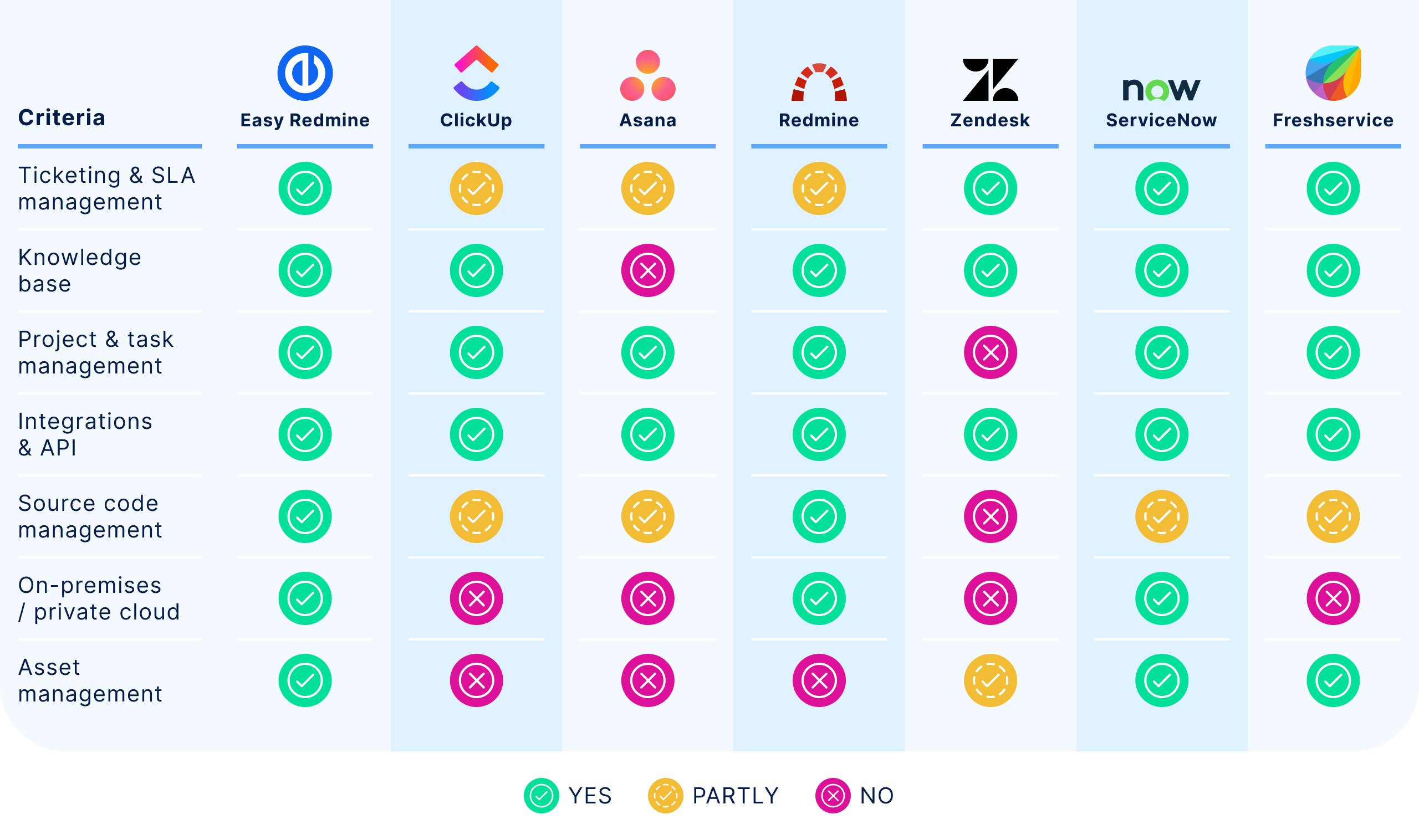
Comparison of key ITSM capabilities across Jira Service Management alternatives
To dive deeper into comparing Jira Service Management alternatives to find the one that suits your organisation.
1. Easy8
When you search for service desk and project delivery in one place, Easy8 should be your choice!
Easy8 explicitly frames ITSM as integrated: an AI-powered Help Desk where you can create tickets from emails, organize them into projects, and keep customers informed with automated notifications. It builds on Redmine as a JSM rival, offering integrated ticketing, SLAs, email-to-ticket conversion, dashboards, alerts, and project overviews for customer support.
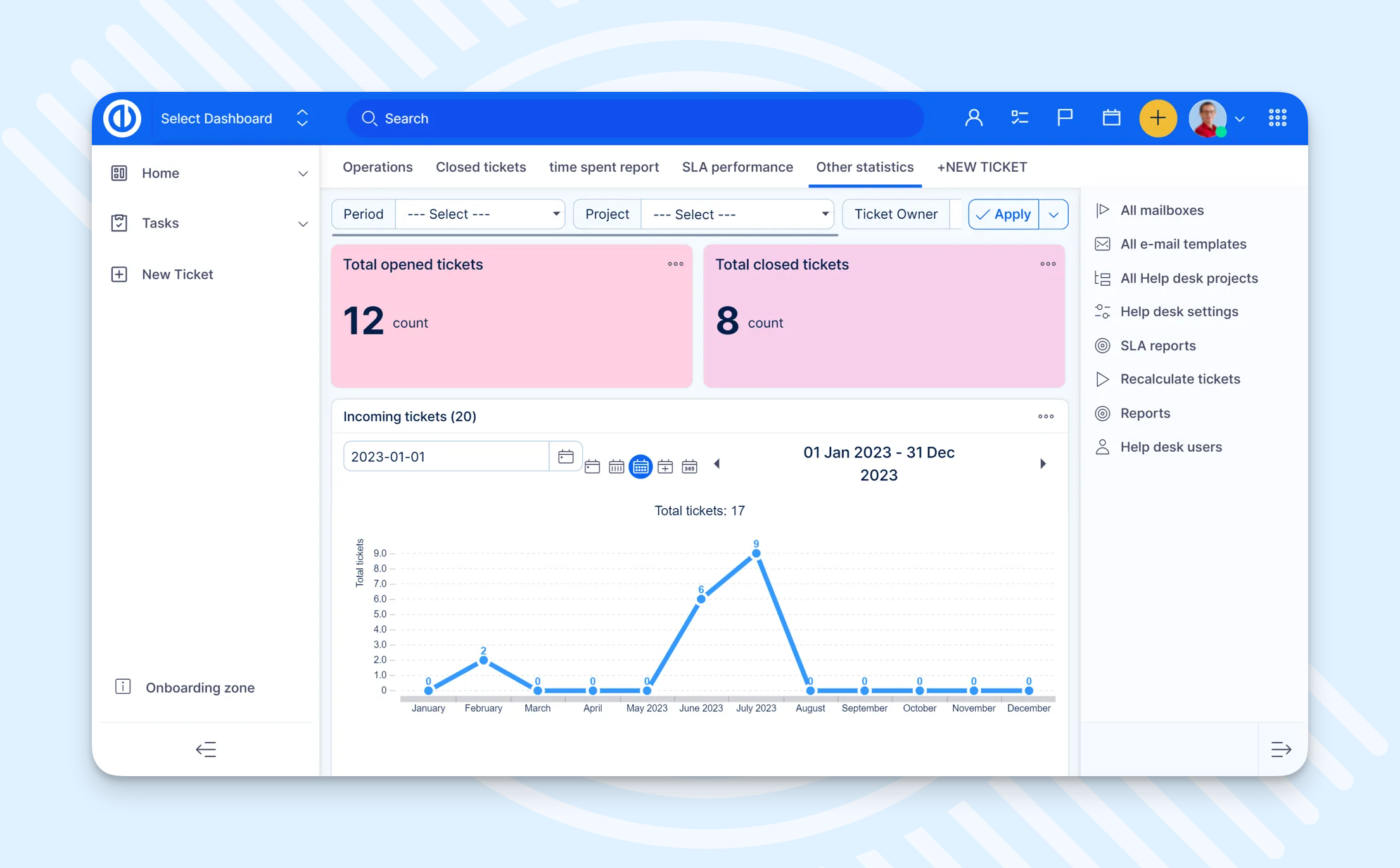
Easy8 HelpDesk interface
Its HelpDesk documentation also references connecting mailboxes and tuning dashboards via the UI.
For knowledge, Easy8 documents a natively integrated Knowledge Base designed to work in synergy with collaboration and team cooperation capabilities.
Easy8's HelpDesk is a relevant alternative to Jira Service Management especially for users seeking cost-effective, customizable, ITSM without JSM's scaling complexities.
Where it fits:
- Strong fit for PM-led organizations that want fewer handoffs between support work and project work.
- Compelling when you are considering replacing Jira Service Management and Jira Software as well (taking into consideration Data Center end of life).
2. ClickUp
ClickUp can cover a Jira Service Desk–style intake flow using Forms (including IT Request Forms) that create and route tasks, plus Help Desk / IT Service Ticket templates to track, prioritize, and resolve requests.
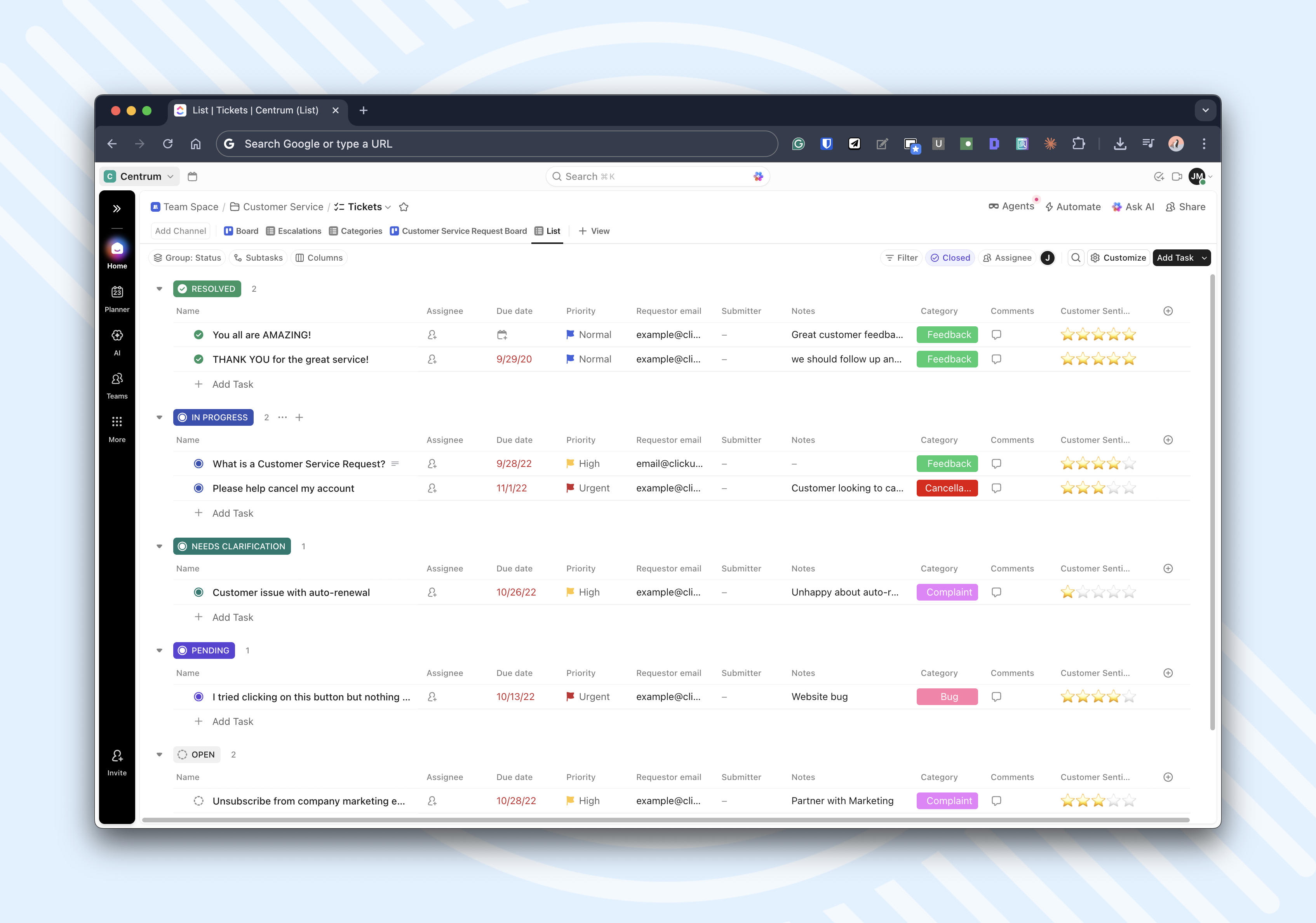
ClickUp tickets interface
For documentation, ClickUp supports building an internal knowledge base structure in Docs alongside execution work.
Compared with Jira Service Management’s service-desk model, ClickUp is suitable when your primary goal is to convert requests into planned project tasks quickly rather than replicate full ITSM mechanics.
Where it fits:
- For organizations that want to replace a fragmented “inbox → spreadsheet → Jira project” flow with one work hub where intake becomes trackable tasks and projects immediately.
- Particularly relevant when you need request intake, documentation and execution in one platform, and you’re comfortable implementing “service desk” practices via forms, templates and automations rather than relying on a dedicated ITSM suite (incident/problem/change/CMDB).
3. Asana
Asana can cover a “lightweight service desk” pattern by using Forms to standardize incoming requests and create tasks, plus templates like Work Requests and IT Requests to help teams triage and prioritize intake. Asana is primarily suitable for managing projects and tasks rather than ITSM-native workflows.
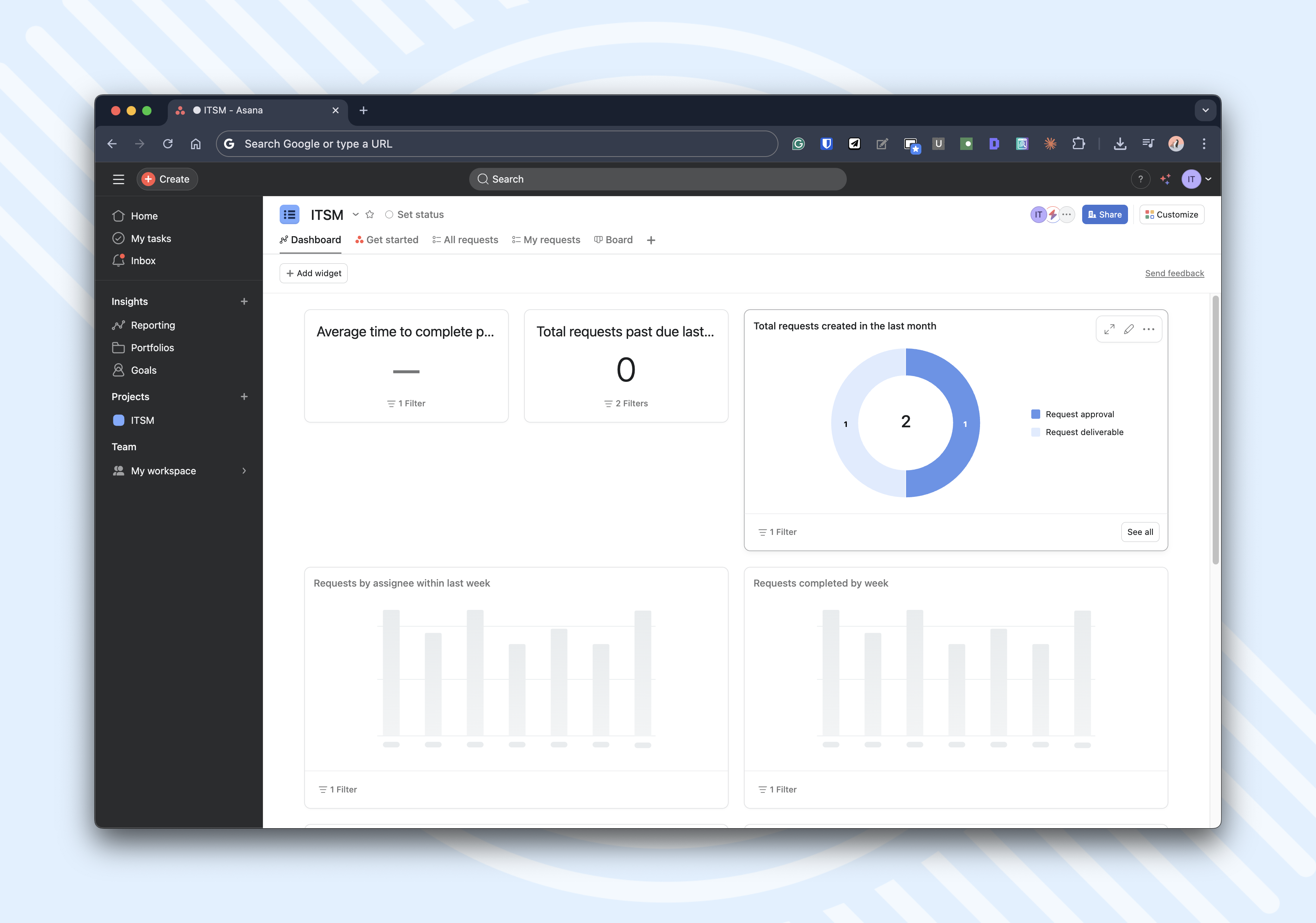
Asana ticket dashboard interface
Where it fits:
- When the goal is to turn requests into planned project work quickly, not to replicate JSM’s full ITSM operating model.
4. Redmine
Redmine’s core strengths are PM fundamentals: multi-project support, flexible issue tracking, Gantt, wiki, and issue creation via email.
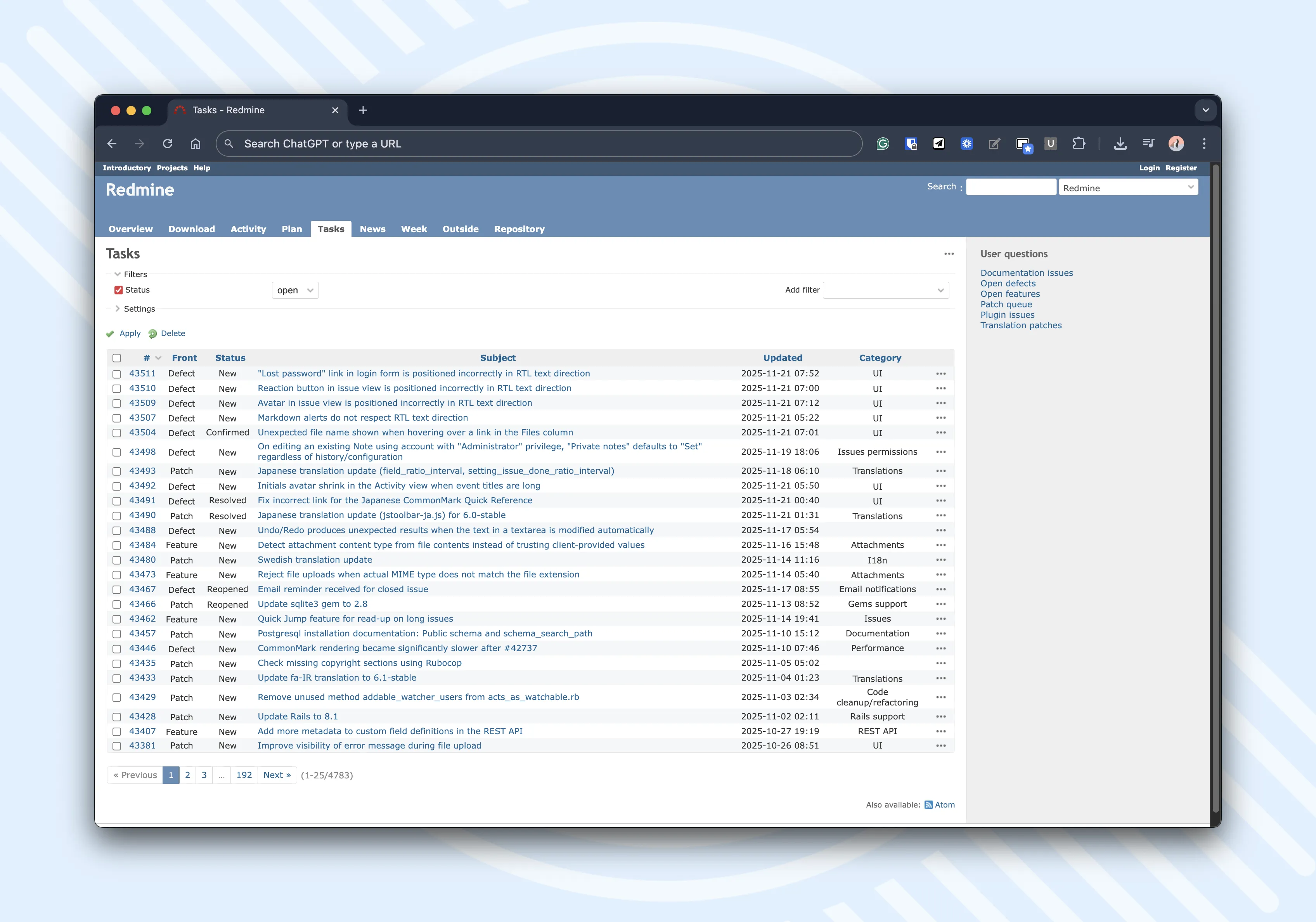
Redmine issue list interface
Where it fits:
- Good option when you need self-hosted control and can accept that ITSM features often require configuration/plugins.
- Strong for technical teams comfortable assembling their own service desk stack.
5. Zendesk
Zendesk’s positioning is classic CX: ticketing that consolidates email, messaging, phone, social, and more into one place, with automation.
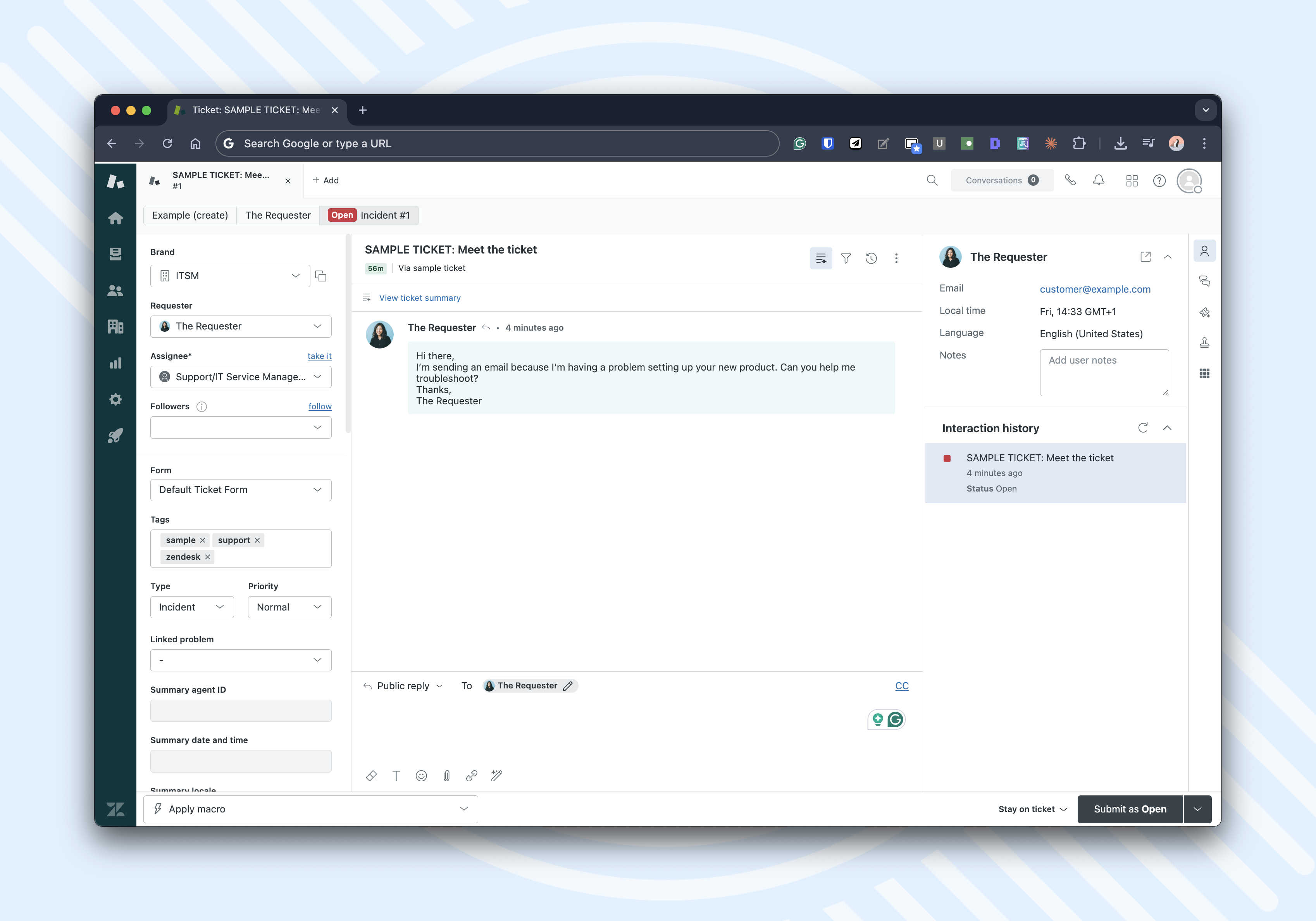
Zendesk interface
For knowledge, Zendesk Guide is framed as a self-service help center to empower users and agents. Zendesk also documents SLA policies as a first-class operational control.
Where it fits:
- When your service desk is primarily customer support and you want strong omnichannel and self-service.
- ITSM depth (change/problem/CMDB) is not the core value; delivery linkage is usually via integrations.
6. ServiceNow
ServiceNow positions its ITSM capabilities as a way to automate the handling of incidents, problems, and changes at enterprise scale.
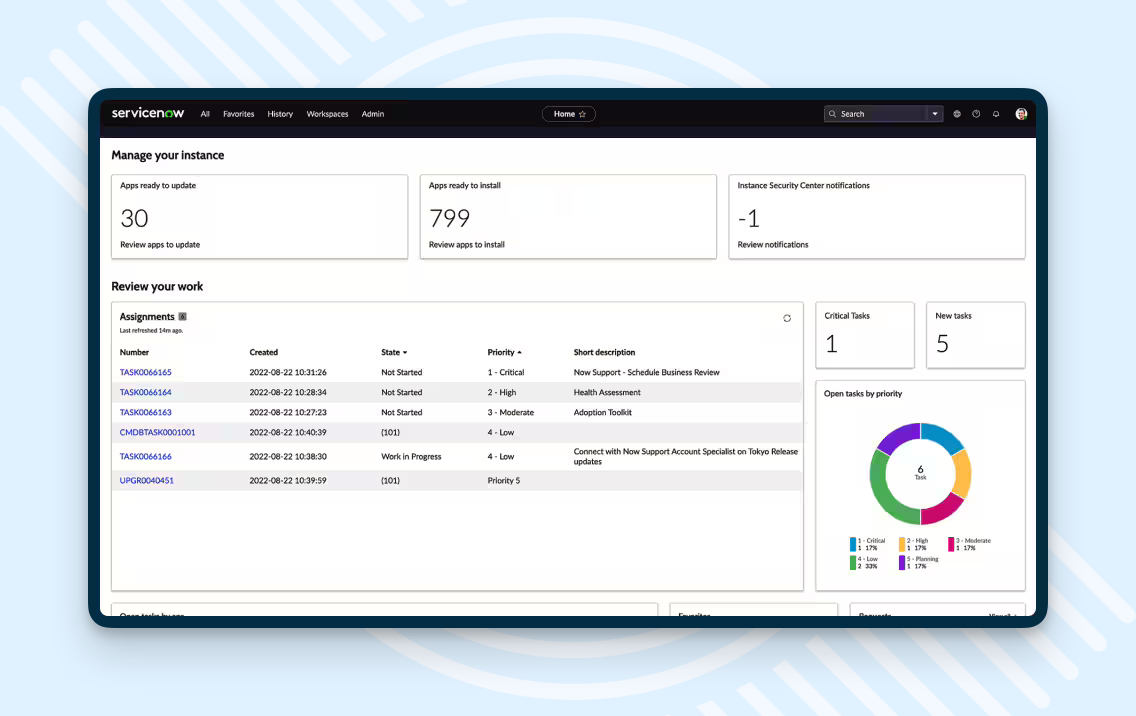
ServiceNow interface
It emphasises Knowledge Management to boost both self-service and agent productivity, while promoting its CMDB as a reliable source of truth for configuration item data and their interdependencies.
Where it fits:
- When you need deep governance, standardized workflows, and enterprise reporting.
- Typically higher implementation effort; best when process maturity is already high.
7. Freshservice
Freshservice highlights a practical ITSM bundle: incident, change, and problem management, omnichannel support, service catalog, knowledge management, SLA management, and even project management features on the same platform.
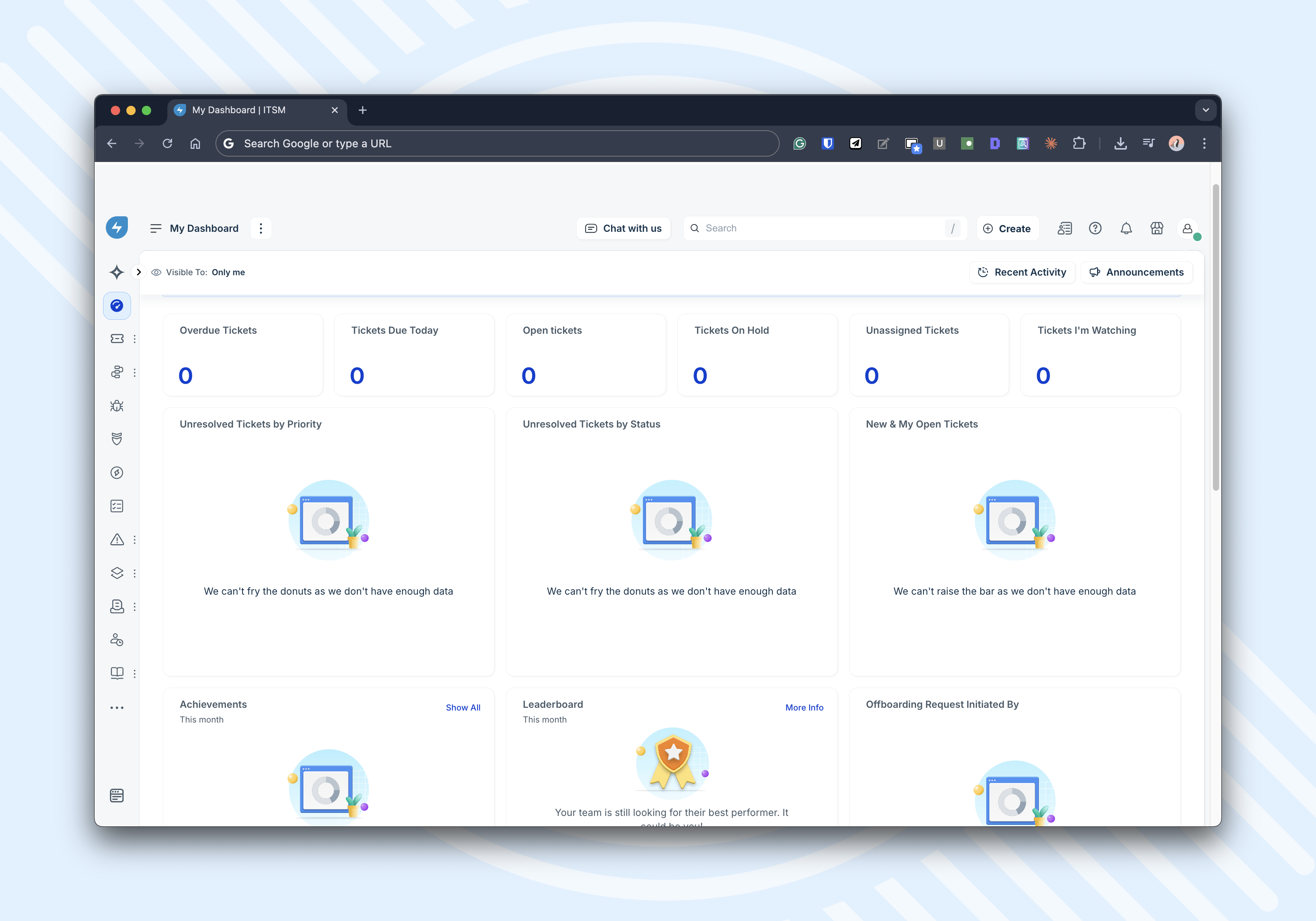
Freshservice interface
It also positions CMDB as a way to track CIs and relationships for impact-aware operations.
Where it fits:
- For organizations that want “Jira Service Management-like ITSM” without the complexity of a full enterprise suite.
- Particularly relevant when PMs want a clearer bridge from ticket work to planned work.
Why Easy8 stands out among Jira Service Management alternatives
Teams are moving away from Jira Service Management because rising costs, configuration complexity, and plugin dependency make it harder to scale ITSM alongside real project delivery.
The alternatives compared here demonstrate that selecting a better fit involves turning those frustrations into clear criteria and choosing a platform that supports tickets, SLAs, knowledge, and projects together, without unnecessary overhead.
Easy8 replaces the entire Atlassian stack in one platform, covering service desk (via HelpDesk), documentation (thanks to Knowledge Base), assets, and project delivery, so you don’t need Jira Service Management, Confluence, or Jira Software.
It also supports hybrid Agile and Waterfall work across IT and non-IT teams. Still hesitating?
Here’s why Easy8 is worth a closer look:
- All-in-one platform combining HelpDesk, ITSM, and project management
- Core features like Knowledge Base and automation are built in
- Transparent pricing, on-premise option, and native support for multi-client setups
Try Easy8 HelpDesk today and simplify how you support and deliver projects.

Frequently asked questions
Is Jira Service Management ITSM?
Yes, Jira Service Management (JSM) is a full ITSM (IT Service Management) solution. It provides ITIL-aligned processes for managing IT services end-to-end, from incident resolution to change enablement.
Is Jira Service Management a ticketing system?
Yes, Jira Service Management (JSM) is fundamentally a ticketing system. It enables teams to collect, track, prioritize, and resolve service requests, incidents, and issues through structured tickets.
What does Jira Service Management include?
Jira Service Management (JSM) is Atlassian's comprehensive ITSM and ESM platform, built on Jira, offering tools for service desks, IT operations, and cross-team workflows.
JSM includes ITIL-aligned modules like incident, problem, change, and request management, with customizable workflows and approval processes.
It features asset and configuration management (via Assets/Insight app), service request portals, knowledge bases integrated with Confluence, and SLA tracking with real-time dashboards.
Is JSM similar to ITSM?
Yes, JSM (Jira Service Management) is highly similar to ITSM (IT Service Management), as it is purpose-built as an ITSM platform. JSM extends Jira with dedicated ITSM features like incident management, request fulfillment, change management, SLAs, and customer portals, aligning closely with ITIL best practices.
Is Jira Service Management the same as Jira Service Desk?
No, Jira Service Management is not the same as Jira Service Desk, but they are closely related.
Jira Service Desk was the original product launched by Atlassian in 2013 for IT service desk and basic ITSM needs, focusing on request management, queues, and customer portals.
Atlassian rebranded and evolved it into Jira Service Management around 2020-2021, adding advanced ITSM features like asset management (Insights), SLAs, incident alerts via Opsgenie, and broader support for non-IT workflows such as HR or facilities—while retaining all core Service Desk functionality.
Existing Jira Service Desk instances automatically upgraded to Jira Service Management, making the older name largely legacy, though some users and docs still reference it interchangeably.
How to find Jira Service Management?
Jira Service Management is Atlassian's official product, accessible directly through their website or Atlassian Cloud/Data Center/Data Center deployments.
Please note that Jira Data Center will end in 2029. Support for all Data Center products, including Jira Software and Jira Service Management, will end. After this date, security updates, technical support and bug fixes will no longer be provided.
What is Jira Service Management?
Jira Service Management is Atlassian's enterprise service management platform, evolving from the original Jira Service Desk to provide comprehensive IT service management (ITSM) and support capabilities.
What is the Jira Service Desk?
Jira Service Desk is Atlassian’s service management and help desk product built on top of the Jira platform, designed for handling requests, incidents, problems, and changes from customers and internal users. It has since been rebranded and expanded as Jira Service Management, but many people still use the old name “Jira Service Desk” to refer to the same family of capabilities.
What is the alternative to Jira Service Desk?
Alternatives to Jira Service Desk include several robust tools such as Easy8 HelpDesk, Zendesk, Freshdesk, Zoho Desk, SolarWinds Service Desk, and open-source options like Zammad and Redmine. These alternatives provide varying features like omnichannel support, automation, incident management, shared inboxes, customizable workflows, and knowledge bases.
Related articles

The end of Jira on-premises: Atlassian Data Center terminates support
Atlassian is discontinuing Jira Data Center, and with it, the last on-premises option for Jira users. By 2029, support and updates will be gone entirely. The countdown has started: migrate to the cloud, plan a hybrid setup, or find a true on-premises alternative before the clock runs out. The first phase will be here by the end of March 2026.

Easy8 (formerly Easy Redmine) vs. Jira: A comparison of project management software
Still not sure if Jira is the right fit for your projects? Read this comparison to discover why more and more teams are switching to Easy8, and why it could save you time, money and frustration.

Less expensive alternative for Jira on-premises
Jira Server was discontinued in 2024 and Jira Data Center is now on a fixed countdown: new customers can no longer buy it, and every instance goes read-only in 2029. If you run Jira on your own servers, the question is what each option costs you – and whether a less expensive on-premises alternative fits your team.