The end of Jira on-premises: Atlassian Data Center terminates support
Atlassian is discontinuing Jira Data Center, and with it, the last on-premises option for Jira users. By 2029, support and updates will be gone entirely. The countdown has started: migrate to the cloud, plan a hybrid setup, or find a true on-premises alternative before the clock runs out. The first phase ended in March 2026.

Table of contents
Jira on-premises sunset
Jira data migration options
1. Migrate to Atlassian Cloud
Bitbucket Hybrid License
Jira data migration support
2. Continue with Data Center
3. Migrate to Jira on-premises alternative: Easy8
Jira Data Center EOL: Potential risks
1. Compliance and security issues
2. Jira migration complexities
3. Practical and operational challenges
Easy8: Secure Jira on-premises alternative
Where Atlassian falls short and how Easy8 solves it
Switch to a Jira Data Center alternative: Easy8
TL;DR
Atlassian ends Jira Data Center on 28 March 2029, when instances and Marketplace apps turn read-only, and existing customers can only buy licences until 30 March 2028, leaving cloud as the only Atlassian path. Easy8 is a Jira on-premises alternative you can deploy today on your own servers, in a private cloud or air-gapped, and we migrate your Jira data with n8n, keeping custom fields and attachments.
Jira on-premises sunset
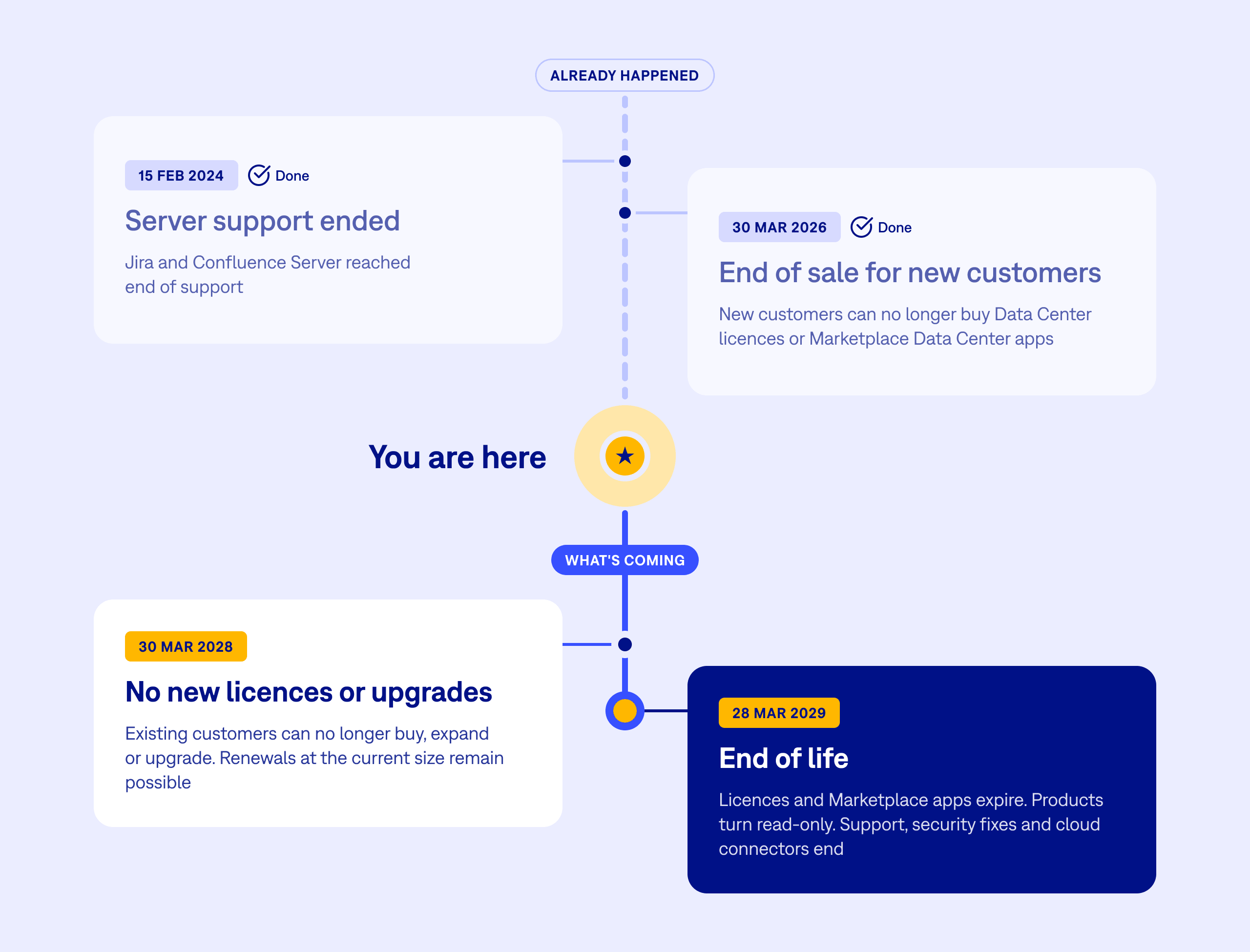
On 8 September 2025, Atlassian announced that it was sunsetting Atlassian Data Center products. The transition follows a three-year phased approach:
- March 30, 2026: End of new feature development for Data Center products; support limited to security and maintenance updates only
- March 30, 2028: Final date for existing customers to renew Data Center licenses and Marketplace app purchases
- March 28, 2029: Complete end of life - all support, downloads, and renewals cease; products switch to read-only mode
Many organizations, especially those with unique security requirements or government agencies, are concerned about the shift to cloud-based solutions. The inability to keep data on-premises poses significant challenges for industries like healthcare, where Atlassian cloud products are not automatically HIPAA compliant. Nonprofits also face difficulties due to the lack of discounts for Data Center licenses. There are several reasons to look for a Jira alternative.
Jira data migration options
Jira's clients should begin evaluation all the options immediately to ensure smooth transitions and avoid last-minute complications.
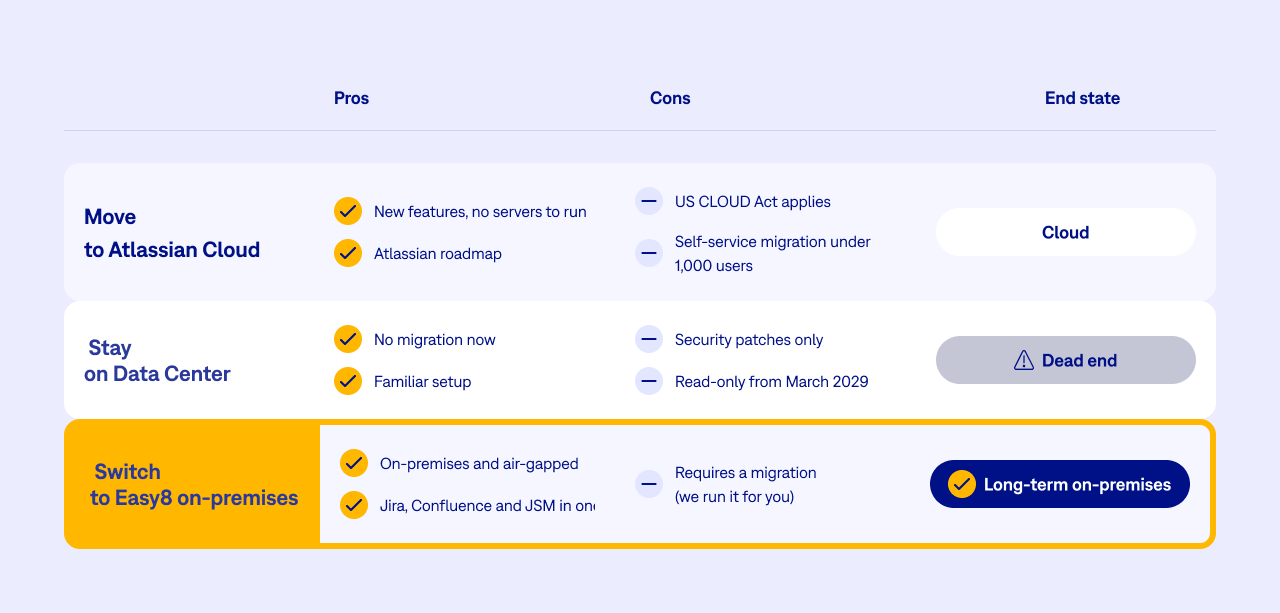
1. Migrate to Atlassian Cloud
Atlassian's primary path involves moving to their cloud platform. There are several migration methods:
- Lift-and-shift: Complete migration in a single downtime window, recommended for teams under 10,000 users
- Fresh start: Clean migration with selective data transfer for simplified cloud setup
- Phased migration: Staged approach for larger organizations with complex requirements
Bitbucket Hybrid License
Bitbucket Data Center and Bamboo Data Center are the exception: Atlassian will not discontinue them in 2029 and will continue to support them beyond that date through the Bitbucket Hybrid License. This license combines access to Bitbucket Data Center, Bamboo Data Center, and Bitbucket Cloud with Pipelines under a single subscription.
The license is expected to become available in early 2027 (it was originally announced for release in mid-2026) and is intended only for existing Bitbucket Data Center, Bitbucket Server, Bamboo Data Center, and Bamboo Server customers. After March 28, 2029, Bitbucket Data Center and Bamboo Data Center instances that do not move to the Hybrid License will become read-only; users will not be able to push code or make any other changes
If you are leaving Jira and Confluence anyway, keeping code in Bitbucket still ties you to Atlassian licensing. Easy8 integrates with GitLab, so project management and source code can both stay on your own infrastructure.
Jira data migration support
Atlassian offers different levels of cloud migration support based on company size:
- Companies with fewer than 1,000 users must rely on self-service tools, without Atlassian support.
- Those with more than 1,000 users can access dedicated help through the FastShift Program.
- For organisations with over 5,000 users, Atlassian provides a tailored Solution Design Acceleration program for complex migrations.
2. Continue with Data Center
Organisations relying on Atlassian Data Center can continue using their current deployments until 2029. Existing licenses can be renewed through to March 2028, offering a transitional window to prepare for migration.
However, a critical limitation was already applied: after March 2026, no new features will be released; only essential security patches will be provided, potentially affecting long-term viability.
3. Migrate to Jira on-premises alternative: Easy8
For organisations unwilling or unable to adopt Atlassian Cloud, there are several alternatives such as Easy8 on-premises. It provides a comprehensive solution that unifies project management, source code management and ITSM, helping teams collaborate more effectively and deliver high-quality results.
Instead of relying on a stack like Jira Software, Confluence, and BitBucket, businesses can opt for Easy8 combined with Knowledge Base 2.0 and GitLab. Anyway, to get a clear and whole picture of how Easy8 is Jira's on-premises relevant alternative, read through the comparison of Jira vs. Easy8.
Jira Data Center EOL: Potential risks
With the first phase of Atlassian’s Data Center sunsetting kicking off this March (2026), the clock is officially running out. This forced transition is causing widespread concern among Jira Data Center clients, especially organizations in highly regulated industries that rely on strict data control.
As the reality of losing a true on-premises solution sets in, here are the critical pain points and risks facing organizations today:
1. Compliance and security issues
- US jurisdiction and CLOUD Act: Even if data is hosted in EU data centers, Atlassian remains a US-based company subject to US laws like the CLOUD Act. This means US authorities can compel access to data, potentially without notifying the client. The Atlassian Government Cloud narrows Atlassian's jurisdiction and compliance gap for eligible US federal customers, but doesn't touch data sovereignty, non-US public sector, or the FedRAMP High/IL5 gap.
- Data location and sovereignty: Companies with strict data residency requirements, such as those in government, healthcare, or finance, find it challenging to migrate to a cloud solution that might not guarantee data sovereignty.
2. Jira migration complexities
- High costs and resource intensive: Migrating to Jira Cloud is a complex and costly process that can take a significant amount of time and resources.
- Feature parity and integrations: There are concerns about the feature parity between Jira Data Center and Jira Cloud, especially regarding custom scripts and integrations.
3. Practical and operational challenges
- Single-tenant isolation: While Atlassian's Isolated Cloud offers single-tenant isolation, it might not be sufficient for highly regulated industries.
- Third-party plugins: The transition might affect the compatibility and support for third-party plugins, which are often crucial for extended functionalities.
Easy8: Secure Jira on-premises alternative
The Jira clients of Data Center are now faced with the question of whether to migrate to Atlassian Cloud, choose the hybrid solution, keep Data Center, which will not support any improvements, or welcome the option for an on-premises Jira alternative.
If your organisation has fewer than 1,000 users (which is common among teams using Jira Data Center), you’ll need to manage the migration to the Cloud on your own. That means going through Atlassian’s migration guide, which can be both time-consuming (often taking over 12 months) and technically demanding.
And since you’ll already be investing time and effort into such a complex move, it’s the perfect moment to evaluate whether Jira is still the right choice or if a more integrated, future-proof Jira alternative on-premises might serve you better.
Where Atlassian falls short and how Easy8 solves it
Atlassian’s roadmap leaves Data Center customers with problems the cloud does not fix. Here is how we address each one:
- No on-premises future: Atlassian offers cloud as the only path after March 2029 (even Atlassian’s air-gapped option is not confirmed as generally available by 2029; it is currently in technical design for highly isolated U.S. government/classified workloads). In Easy8, on-premises is a core deployment model, not a legacy option.
- US jurisdiction and data residency: Atlassian Cloud remains subject to the US CLOUD Act, even in EU data centres. With Easy8, your data stays on your own servers, and in an air-gapped setup no vendor can reach it.
- Rising costs: Data Center price increases and paid Marketplace apps make the budget hard to predict. Easy8 includes Knowledge Base, HelpDesk and Resource Management natively, so you pay for fewer add-ons.
- Migrating on your own: Companies under 1,000 users get only Atlassian’s self-service tools, and a move to the cloud often takes over a year. Our team runs a free migration pilot and transfers custom fields and attachments for you.
- Feature freeze: Data Center has received no new features since March 2026. Easy8 keeps shipping new releases for on-premises customers.
Switch to a Jira Data Center alternative: Easy8
While Atlassian Cloud platforms offer convenience and rapid deployment, Easy8, the No. 1 Private WorkOps platform, provides unmatched control, security, and cost predictability for organizations with specific compliance, customization, or sovereignty requirements.
Easy8 is a Jira Data Center alternative for teams that need to keep running on their own infrastructure after 2029. You deploy it on-premises, in a private cloud or fully air-gapped, and you decide when to upgrade.
Instead of rebuilding your stack around Atlassian Cloud, you move your Jira projects, issues, custom fields and attachments into Easy8 with our n8n-based migration, and your teams keep working with familiar issue tracking and Scrum and Kanban boards.
If you're looking for a secure, on-premises alternative to Jira, there’s no need to let migration fears hold you back. Watch our webinar recording to see a live demonstration of a real-world Jira data migration.
And then? Book a free Jira data migration pilot to experience how n8n automation perfectly preserves your custom fields and attachments in Easy8.
Frequently asked questions
What are the disadvantages of using Jira?
Jira’s flexibility and depth come with a steep learning curve and significant administrative overhead, as teams must master complex configurations and dedicate resources to ongoing maintenance. Large instances can suffer performance bottlenecks and require disruptive re-indexing, while licensing and add-on costs quickly escalate.
Over-customisation risks process fragmentation and upgrade headaches, and native reporting tools are limited without additional plugins or BI integrations. Finally, the crowded UI and integration complexity can hinder adoption and create data silos if not carefully managed.
What is the best Jira alternative?
Many teams seek alternatives due to Jira's complexity, cost, or specific feature needs. Several tools offer compelling options, each with unique strengths suited for different kinds of teams and workflows. Among them is Easy8, which provides open source solutions to 25+ team members.
Organizations considering switching from Jira may find Easy8 particularly appealing due to its hybrid project management capabilities, extensive feature set, greater data control, and lower operational costs—all crucial factors for modern, security-conscious, and cost-sensitive teams.
What does the CLOUD Act do?
The CLOUD Act, enacted in 2018, amends U.S. law to clarify how law enforcement accesses data stored by U.S. tech companies, regardless of server location.
It compels providers to disclose customer data on U.S. servers or abroad via warrants, while allowing challenges if foreign privacy laws conflict, and enables bilateral agreements with other nations for reciprocal access to combat serious crimes.
What is Atlassian Isolated Cloud?
Atlassian Isolated Cloud is a single-tenant cloud deployment option from Atlassian, designed for enterprises needing high security, data sovereignty, and compliance controls. It provides dedicated infrastructure in a fully managed virtual private cloud, bridging the gap between a self-hosted Data Center and multi-tenant Commercial Cloud.
Is on-premises the same as air-gapped?
No, and the difference is the point. On-premise means the software runs on infrastructure you control. Air-gapped means that infrastructure has no physical or logical connection to the internet or any unsecured network.
Most on-premises tools still assume a connection for licensing, updates or avatars, so an air gap is a stricter requirement that has to be tested rather than assumed.
How much does Jira Data Center cost?
Jira Software Data Center, Atlassian's self-hosted (on-premises) edition, starts at $59,000 per year for the smallest tier of up to 500 users, billed annually. The price rises in steps by user tier, and the largest tiers are quoted rather than published.

Related articles

Jira price increase 2021-2026: Every rise calculated
Jira Cloud prices have risen every October for five years, and the sixth increase lands on 13 October 2026. Each rise looks small on its own, but they compound. Find out what Jira actually costs per user from October, and what to check before your renewal date.

Jira Data Center vs. Jira Cloud: The complete 2026 comparison guide
Jira Data Center is officially on borrowed time, with feature development on hold and a hard "read-only" sunset scheduled for 2029. Jira Cloud is not suitable for industries that require strict security and compliance. Jira Server is already obsolete. What should you do? Read on!

Moving from Jira on-premises? Step-by-step guide with n8n migration tool (2026)
With Atlassian's announcement of Jira Data Center end-of-life and the ongoing push toward cloud-only solutions, thousands of organisations are reassessing their project and issue tracking tools. The question is no longer if you should consider on-premises alternatives, but how to execute a smooth transition without disrupting your teams' productivity. This guide walks you through everything you need to know: the migration scope, the process, what to expect, and how to get started with a migration pilot.