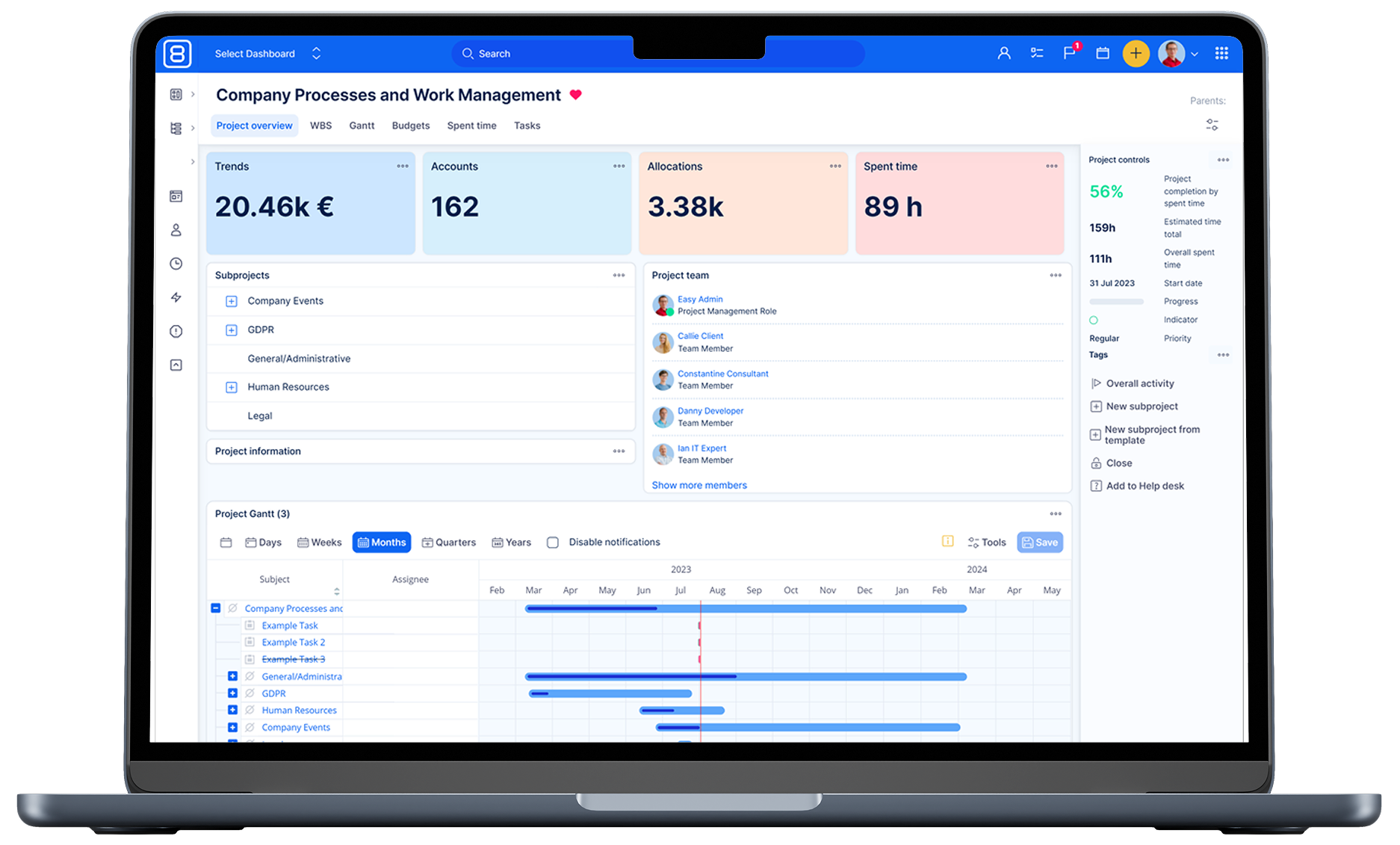
On-premises deployment: Take control of your project management data
Deploy Easy8 behind your firewall for maximum security and control. Perfect for organisations that need to keep sensitive project data in-house.

Complete data control
Keep your project data and intellectual property (IP) secure behind your firewall.

Flexible deployment options
Choose between Docker, virtual machines, or custom installation.

AI-powered features on your terms
Use AI assistance for project management while keeping data safe in your infrastructure.

Switch anytime
Easily migrate between on-premises and cloud deployment as your needs change.

Why businesses need on-premises project management software
In today's digital transformation era, protecting your intellectual property and maintaining data control is vital. As software becomes central to core business operations, your project management system can't be the weakest link.
Technology teams working on complex Industry 4.0 projects need robust solutions that guarantee data security and control over system uptime. This is where on-premises (server) deployment makes the difference.
A few specifics to consider:
- Your core systems run on custom software and algorithms that need protection.
- Competitors and third parties are actively seeking ways to access proprietary data.
- Government regulations require strict control over sensitive information.
- Mission-critical systems demand guaranteed uptime and rapid issue resolution.
- AI companies might collect and expose your intellectual property through cloud services.
Cloud vs. on-premises and air-gapped:
Companies are reevaluating their cloud strategies, shifting towards a balance between cloud utilisation and on-premises infrastructure. Many organisations have discovered that long-term cloud costs often exceed expectations, leading to a growing preference for hybrid or on-premises solutions, a trend known as the "cloud exit".
This approach enables businesses to regain control over their data, reduce dependency on major cloud providers, and achieve cost efficiencies. A Citrix survey, published in February 2024, reveals that 42% of organisations in the United States are considering or have already transitioned at least half of their cloud workloads back to on-premises infrastructures.
An air-gapped deployment goes further: the system runs on an air-gapped network with no connection to the public internet, the norm in defence, government, energy, healthcare and finance, where NIS2, DORA and ISO 27001 require provable data sovereignty. In an air-gapped environment data never leaves the organisation's perimeter, which removes third-party breach exposure and vendor lock-in, keeps all audit logs in-house, and keeps teams working through cloud outages.
Choose your on-prem deployment method
Docker container (recommended)
- Our recommended deployment method
- Simplified updates and maintenance
- Consistent environment across your infrastructure
- Minimal dependency management
- Makes work easier for DevOps teams

Virtual machine
- Pre-configured environment
- Compatible with VMware and VirtualBox
- Rapid deployment
- Ideal for quick evaluation and testing

Custom installation
- Full control over the installation process
- Suited for specific infrastructure requirements
- Expert support available
- Detailed documentation provided

Specific industries that prefer server solutions over cloud
Organisations that handle sensitive data often prefer on-premises deployment for greater control, compliance, and security. Specifically, industries such as healthcare, financial services, government, manufacturing, engineering, and utilities choose on-premises solutions over cloud-based alternatives to meet their unique operational, regulatory, and security requirements. Explore our solutions tailored to your industry.

AXA Group's case study of on-premises deployment
Discover how AXA Group Czech Republic and Slovakia leveraged an on-premises server solution from Easy Project (Easy8 for the Czech market) to meet their strict internal security requirements. Read the full case study to see how on-premises solutions can work for your organization.

Ready to run project management on your own infrastructure, or fully air-gapped?
Keep your sensitive project data safe with on-premises Easy8. Get complete control of your deployment while keeping all the powerful features, including on-premises AI.
Choose between yearly subscription or one-time payment to match your budget needs.
Our dedicated team helps you with:
- Initial setup and configuration
- Migration from other systems
- Performance optimization
- Air-gapped installation and offline updates
- Security hardening
- Regular maintenance
Commitment to on-premises security and privacy

Filip Morávek
Trusted by the best


Read our blog articles about on-premises

Recognized by Yahoo Finance: Easy8 runs the first AI on-premises
For organizations handling sensitive data, choosing between cloud and on-premises solutions is critical. We believe companies shouldn't have to compromise between flexibility and full control over their data and intellectual property. That's why the launch of the first on-premises AI in project management is a major milestone, gaining global attention.

How Docker improves the security of on-premises solutions
Easy Software is pleased to announce official support of on-premises solution via Docker solutions. This article focuses on the security benefits. I strongly believe you will find them worth the smaller effort of migrating from the legacy solution.

Hybrid cloud explained: Why the future of enterprise IT is hybrid
In today's accelerated environment of digital transformation, the cloud is no longer a fringe IT initiative. It is the foundation of business operations. Yet, for mid-to-large organisations navigating complex regulatory environments and massive legacy investments, the path forward is rarely all public cloud. Instead, a pragmatic, integrated approach has become the strategic standard: the hybrid cloud.
FAQs
Does on-premises mean deployed on your own servers?
Yes, "on-premises" indeed refers to IT infrastructure, systems, software, and data that are deployed on an organization's own servers or within its facilities. This means that the organization owns and manages the hardware and software locally, as opposed to utilizing cloud services provided by third-party vendors.
Can Easy AI be deployed on-premises?
Yes! With Easy AI for Easy8, you have the unique flexibility to choose between cloud hosting or on-premises deployment for your project management AI.
What is Docker and why is it used?
Docker is an open-source platform that enables developers to create, deploy, and manage applications using containerization technology. Docker allows developers to package applications along with all their dependencies into containers. These containers are lightweight, portable, and can run consistently across various computing environments. A Docker container includes everything needed to run the application, such as code, libraries, and configuration files, ensuring that it operates the same way regardless of where it is deployed.
Why is Docker so popular?
Docker is popular thanks to its ability to simplify software development and deployment while offering robust features that address scalability, portability, flexibility, and security needs effectively. Its ease of use, combined with a strong community ecosystem and continuous improvements, has made it an essential tool in modern DevOps workflows.
What is the difference between cloud AI and on-premises AI?
The choice between cloud AI and on-premises AI largely depends on an organization’s specific needs regarding cost management, performance requirements, data security concerns, and customization capabilities. Each approach has its advantages and challenges that must be carefully evaluated before making a decision.
When considering Cloud AI, it operates on a pay-as-you-go model, resulting in variable costs that can scale with usage. Performance-wise, it offers high scalability, making it ideal for handling growing workloads, though it may be subject to potential latency issues. Scalability is a strong suit, as cloud AI can easily adjust to demand without significant infrastructure changes. However, users have limited control over the infrastructure, as much of it is managed by third-party providers. In terms of security, cloud AI offers advanced features, but it requires placing trust in external providers to maintain data security and privacy.
On the other hand, On-Premises AI requires a significant upfront investment but offers predictable ongoing expenses, which can be beneficial for long-term budgeting. It generally provides better performance in terms of low latency, as all processes occur within the local infrastructure. However, scalability is limited by the existing hardware, which may require additional investments to expand. The key advantage of on-premises AI is the level of control it offers—users have full control over the system, from hardware to software. This also extends to security, where organizations can implement custom security measures tailored to their specific needs, without relying on third-party trust.
Which is correct: on-premises or on-premise?
The correct term is "on-premises." This term refers to something located on a site or property, typically in the context of IT infrastructure, such as software or hardware that is hosted locally rather than in the cloud. Additionally, some professionals prefer the abbreviation "on-prem" for casual contexts, which is widely accepted.
In contrast, "on-premise" is considered incorrect in this context. The word "premise" refers to a proposition or statement used as a basis for argument, which does not apply to physical locations. Therefore, using "on-premise" in place of "on-premises" is a common grammatical error that is often seen in marketing and tech discussions.
What is the minimum hardware requirement for on-premises solution?
The minimum hardware requirements for server solution, suitable for 25 users, include an Intel Xeon E5440 @ 2.83GHz processor, 4 GB of memory, 20 GB of disk space, and a network card. For more details find out more about larger implementation.
What are the software requirements for on-premises solution?
The software requirements for an on-premises setup include Docker Engine version 24.0.5 (recommended), support for all major operating systems, and a database such as Percona 8.x. A full list of compatible software is available in the documentation.
Docker tools are emphasised because they are the only true necessities when opting for a Docker-based solution. With Docker, there’s no need to configure additional dependencies such as operating systems or other components, simplifying the setup process. This is why we strongly recommend Docker for a hassle-free installation experience.
For direct (legacy) installations, server administrators must pre-install the specified requirements to successfully implement, update, or upgrade Easy8. The choice of deployment determines the ease of installation and ongoing management, making Docker a practical and efficient choice.
Read more about software requirements to receive all detailed information.
What does air-gapped mean?
An air-gapped system is a computer or network that's physically isolated from the internet and other unsecured networks, with no direct connection to the outside world. This isolation is a security measure meant to protect sensitive data or critical systems from remote attacks.
Does air-gapped mean no internet?
Mostly yes, but it means more than that. Air-gapped means a system is physically isolated from all untrusted networks, which includes the public internet but also any other network the organization does not fully control.
So no internet is part of it, but a truly air-gapped machine also has no link to the regular corporate network, Wi-Fi, Bluetooth, or any other outside connection.
What is an example of an air-gapped network?
A common example of an air-gapped network is the classified network used by military and intelligence agencies to handle secret information, which runs entirely separate from the public internet with no physical or wireless connection between them.
Another everyday example is the control network for a power plant or factory floor, kept isolated so that a breach of the corporate office network cannot reach the systems running physical equipment.
What is the purpose of an air gap in cybersecurity?
An air gap serves to physically isolate a computer or network from the internet and other untrusted networks, so that sensitive systems have no direct connection an attacker could reach through. The purpose is to create a barrier that remote threats like hackers, malware, and network-based intrusions cannot cross, because there is literally no link to exploit.