Do what your Jira can’t
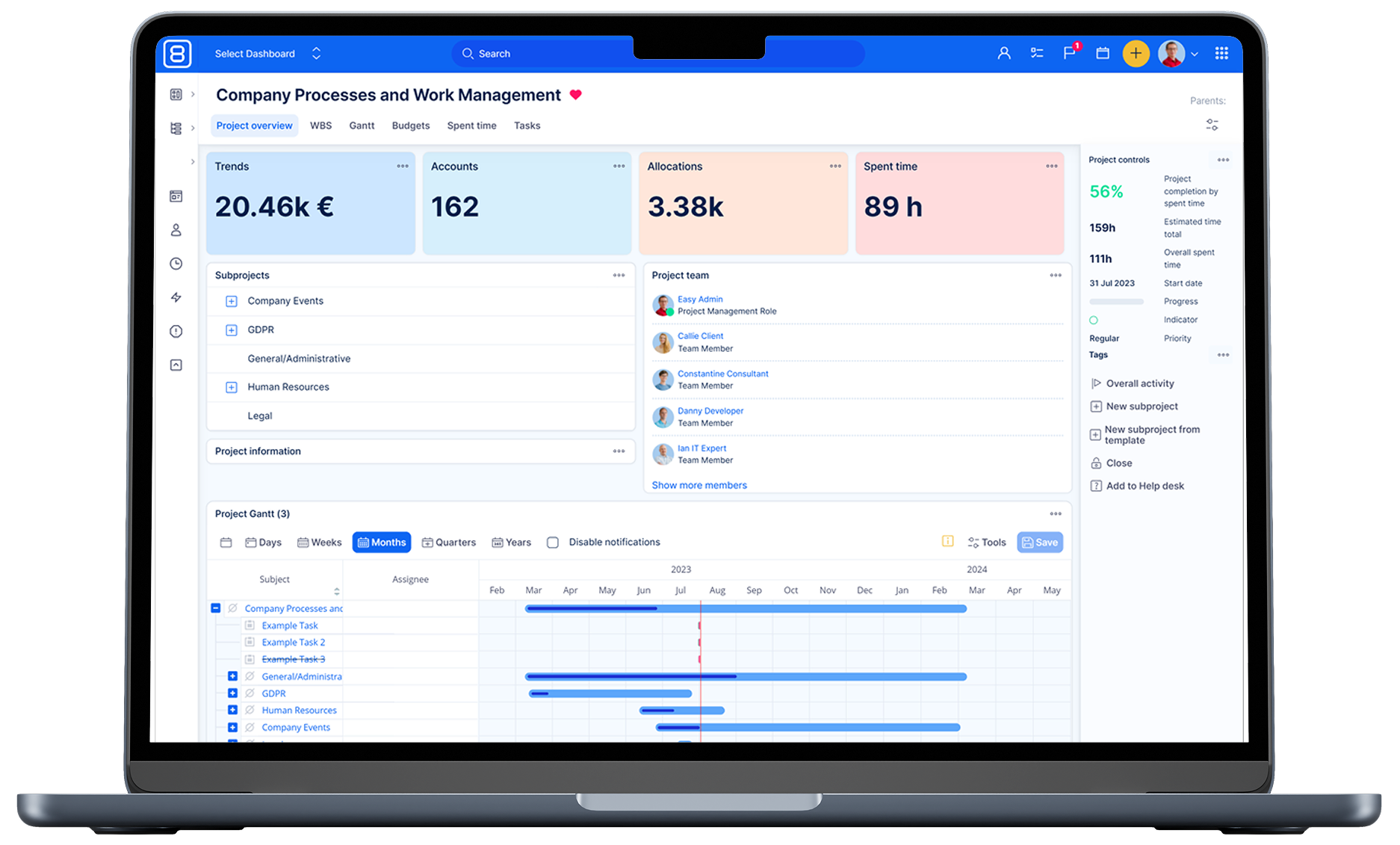
Jira is a powerful project management tool, but it doesn't come with every feature out of the box. Some features not included in the basic settings include advanced reporting capabilities, built-in Gantt Chart functionality, Time Tracking, Project Tree Structure, Custom Dashboards or Mindmaps, and Work Breakdown Structure.

Let’s take a deeper look into these advanced project features and learn how you can improve your project management stack!
Gantt Chart
The Gantt chart is commonly used in the Waterfall methodology of project management. This stands for a linear, sequential approach where progress flows in a downward direction through a series of distinct phases.
The chart is used to plan and schedule the project, with each phase represented by a separate row in the chart. The chart shows the start and end dates of each phase, as well as the dependencies between them. By using the Gantt chart, project managers can identify potential issues early and take corrective action to keep the project on track.
Integrated time tracking
This is the process of measuring the amount of time spent on specific tasks or activities. It is commonly done by recording the start and end times of tasks and can be done manually or automatically by your team members using a time tracker.
It is used to measure productivity, track progress and estimate completion time. Time tracking helps project managers to understand how much time is spent on different tasks and potentially make adjustments as needed to keep the project on schedule.
Project tree structure
Every project consists of tasks and subtasks. The tree structure is used to organize and structure a project in a clear and logical way. It represents the project as a structure of tasks and subtasks, each represented by a node in the tree, with parent tasks branching out to child tasks.
The project tree structure helps managers and teams to understand the overall scope of the project and identify dependencies, critical paths, and potential bottlenecks. It also helps to communicate the project's objectives and tasks to stakeholders. It's usually used in conjunction with other PM tools.
Custom Dashboards
Jira doesn’t let you customize your tabs and dashboards. Personalized views allow users to create a tailored view of the data that is most important to them, easily view and compare data from different sources, create different views for different stakeholders, and easily share them with project teams.
They can help project managers and teams to better understand their projects and make more informed decisions.
Work Breakdown Structure
WBS is used to organize and plan a project. It breaks down the project into smaller, manageable chunks, each level representing a different level of detail, with the topmost level representing the main goal or objective of the project.
It helps managers identify critical tasks, estimate time and resources, identify dependencies, and communicate the project's objectives and tasks to stakeholders. It's usually used in the pre-projecting phase in conjunction with other project management tools.
Mind Maps
Sometimes you just need to get your thoughts in order before the project starts. A mind map is a visual tool used to organize and structure information. It typically consists of a central idea or concept, with branches radiating outwards to represent related ideas, subtopics, or details.
Mind maps can be used to brainstorm, organize thoughts, or simply plan your projects. They can also be used to make connections between different pieces of information and to see the relationships between them.
Easy8: Full-stack Jira alternative everything in one solution
While Jira may be a popular project management tool, it lacks in certain areas when it comes to its basic settings. Easy8 offers a comprehensive solution that includes all the features you need in a single stack, without the need for additional plugins or integrations.
Are you afraid of migration? With Easy8’s professional migration tool and a team ready to help you don’t have to! Try it for yourself - in a 30-day trial!

All-in-one software for a modern project manager? Easy.
Get all powerful tools for perfect project planning, management, and control in one software.

Frequently asked questions
How do I migrate Jira data to a new server?
Migrating Jira data to a new server requires backing up the database, home directory, and installation files from the old server, then installing a fresh Jira instance on the new server and restoring the data. Perform this in a test environment first to verify compatibility and avoid production issues, especially given your prior Jira migration planning.
How to migrate Jira database?
Migrating from Jira to another platform can be a complex process, and it typically involves several key steps:
- Assessment and planning: Before starting the migration, it's crucial to assess the current Jira setup, including the number of projects, custom fields, workflows, and any integrations or add-ons in use. This helps in planning the migration strategy and identifying potential challenges.
- Data export: The next step is to export data from Jira. This can be done using Jira's built-in export tools, such as exporting issues to a CSV file. The export should include all necessary data like issues, attachments, and user information.
- Data mapping and transformation: Once the data is exported, it needs to be mapped to the new platform's data structure. This may involve transforming the data to fit the new system's requirements, such as converting custom fields or workflows to the new format.
- Migration tools: Depending on the target platform, there may be specific migration tools available to facilitate the process. For example, if migrating to a cloud-based system, there might be cloud migration assistants or third-party tools that can help automate parts of the migration.
- Testing: Before performing the final migration, it's important to test the process in a staging environment. This helps identify any issues that might arise during the actual migration and allows for adjustments to be made.
- Execution: After successful testing, the migration can be executed. This involves importing the transformed data into the new platform and ensuring that all data is correctly mapped and accessible.
- Validation and cleanup: Post-migration, it's essential to validate that all data has been migrated correctly and that the new system is functioning as expected. This includes checking for any missing data, broken links, or issues with workflows. Any necessary cleanup should be performed at this stage.
- Training and support: Finally, provide training and support to users to help them transition to the new platform. This ensures that they are comfortable with the new system and can use it effectively.
Each migration is unique, and the specific steps may vary depending on the complexity of the Jira setup and the target platform. It's often recommended to work with experienced professionals or solution partners to ensure a smooth migration process.
Related articles

Moving from Jira on-premises? Step-by-step guide with n8n migration tool (2026)
With Atlassian's announcement of Jira Data Center end-of-life and the ongoing push toward cloud-only solutions, thousands of organisations are reassessing their project and issue tracking tools. The question is no longer if you should consider on-premises alternatives, but how to execute a smooth transition without disrupting your teams' productivity. This guide walks you through everything you need to know: the migration scope, the process, what to expect, and how to get started with a migration pilot.

The end of Jira on-premises: Atlassian Data Center terminates support
Atlassian is discontinuing Jira Data Center, and with it, the last on-premises option for Jira users. By 2029, support and updates will be gone entirely. The countdown has started: migrate to the cloud, plan a hybrid setup, or find a true on-premises alternative before the clock runs out. The first phase will be here by the end of March 2026.

Case Study: Data migration from Jira to Easy8
Read the success story of Istari Vision, a leading technology company renowned for its innovative solutions in project management. Istari Vision recently embarked on a remarkable journey to migrate its data from Jira Software to Easy8, a versatile and user-friendly project management tool.