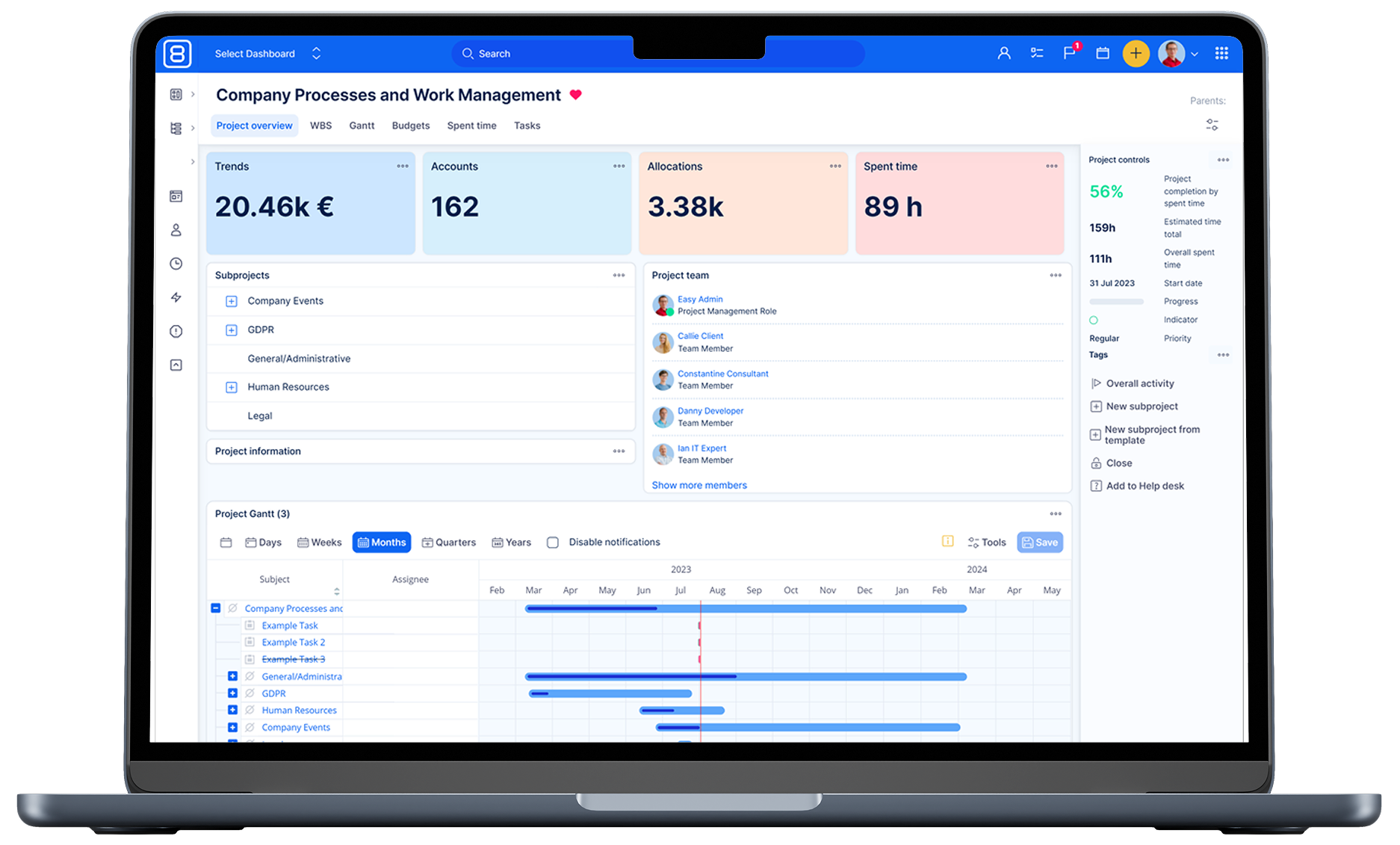
Recorded webinar: How to migrate data from Jira to Easy8
Taking into account Atlassian's recent decision to cease Server support for Jira, this webinar is designed to provide crucial insights for a seamless transition. Our experts showcased a live demonstration of real data migration, offering valuable insights to ensure a smooth and effective transition for your team.

What questions have been discussed on the webinar?
- Risks of staying on an unsupported server
- Security issues and limited functionality
- Live showcase on real data migration process
- Q&A Session
You will surely know what your next steps should be by the end of the webinar. Watch it today.
The webinar webinar recording is ready for you!

All-in-one software for a modern project manager? Easy.
Get all powerful tools for perfect project planning, management, and control in one software.

Frequently asked questions
Do we need to stop using Jira during migration?
Not immediately. During the test migration phase, Jira and Easy8 can run in parallel. This allows teams to validate the migrated environment and ensure everything works as expected.
A short usage freeze window is typically required only during the final production migration.
Can Jira be self-hosted?
Jira can be self-hosted through its Data Center edition, but Atlassian ended support for Jira Server on February 15, 2024, ceasing security updates, bug fixes, and technical support. Data Center, the remaining on-premises option, faces end of life by March 28, 2029, after which it becomes read-only with no new features or renewals past March 30, 2028.
Organizations seeking a self-hosted replacement should consider tools like Easy8, which offers full on-premises deployment with Jira-compatible migration tools, customizable workflows, and ongoing support.
How do I migrate Jira data to a new server?
Migrating Jira data to a new server requires backing up the database, home directory, and installation files from the old server, then installing a fresh Jira instance on the new server and restoring the data. Perform this in a test environment first to verify compatibility and avoid production issues, especially given your prior Jira migration planning.
Related articles

Tired of Jira? Test Easy8 as safe way for Jira migration
When teams move away from Jira, especially with Data Center reaching end of life, they are not looking to start from scratch. They need a reliable transition. Easy8 offers a unified platform that builds on what you already use, while removing limitations and connecting the full project lifecycle. Curious how the transition can work for you? Keep reading!

The end of Jira on-premises: Atlassian Data Center terminates support
Atlassian is discontinuing Jira Data Center, and with it, the last on-premises option for Jira users. By 2029, support and updates will be gone entirely. The countdown has started: migrate to the cloud, plan a hybrid setup, or find a true on-premises alternative before the clock runs out. The first phase will be here by the end of March 2026.

Webinar: Jira Server's end of life – What are your options?
Easy8 is here to help you with Jira Server alternatives and push your projects to the next level. Register for our webinar and get to know why it is important to explore or adapt to this “Server Ends” situation.