AI adoption in Q2 2026: Easy8 survey reveals governance gaps
Most companies now say they've adopted AI. In an Easy8 survey of 79 organisations across five sectors, the majority reported using AI in some form. But adoption isn't the challenge anymore. Governance is. So what now? Keep on reading!

Table of contents
AI adoption without ownership
The AI adoption gap nobody's measuring
Why AI stalls without a single source of truth
Automation is locked behind IT
AI governance (un)maturity
The AI governance maturity model
The takeaway for driving AI in the workplace
TL;DR
Easy8's survey of 79 organisations reveals that while 88% have adopted AI, 81% still lack proper governance, making connected data, clear policies, and secure automation the next critical step.
AI adoption without ownership
If you ask most companies whether they've "adopted AI" and the answer is now yes.
In a recent Easy8 survey of 79 organisations across IT, manufacturing, services, healthcare, and the public sector, 88% said they already use AI in some form. That number sounds like a finish line. Our data says it's barely the starting one.
All questions were closed, with fixed answer options and rating scales. Participants came from Easy8's professional WorkOps education programme and industry channels, so the sample is self-selected rather than nationally representative.
Because the more useful question isn't whether AI is in the building. It's who's in charge of it, and the honest answer, for four out of five organisations, is nobody.
The AI adoption gap nobody's measuring
AI adoption tends to get reported as a single headline percentage. That hides the real story, which lives in two gaps:
- Maturity gap: According to our Q2 survey, 47% of organisations using AI described their usage as mainly experimental, while only 16% had rolled it out across multiple teams. So "88% use AI" mostly means individuals and single teams trying things, not organisations running AI as part of how work actually gets done.
- Governance: Among organisations that use AI, 38% have no governance at all , and another 43% have only basic guidelines, according to our 2026 survey of almost 80 companies. That leaves just 19% with approved tools, written policies, and trained people.
This is how shadow AI takes root. When there's no approved toolset, employees reach for whatever consumer app solves their problem today, pasting client data, contracts, and internal numbers into services no one has vetted.
In regulated industries, that isn't a productivity hack. It's an unmanaged data-exposure risk that already happened.
Why AI stalls without a single source of truth
Here's the part most AI strategies skip. AI is only as good as the data and context you can feed it, and in most organisations, that context is scattered.
In the same survey, 51% of respondents said their organisation has no single source of truth; every team keeps its own version of reality. Only 2% report in near real-time, while 33% still build reports by hand and 46% rely on semi-automated exports and copy-paste.
Meanwhile 81% switch between tools daily or more.
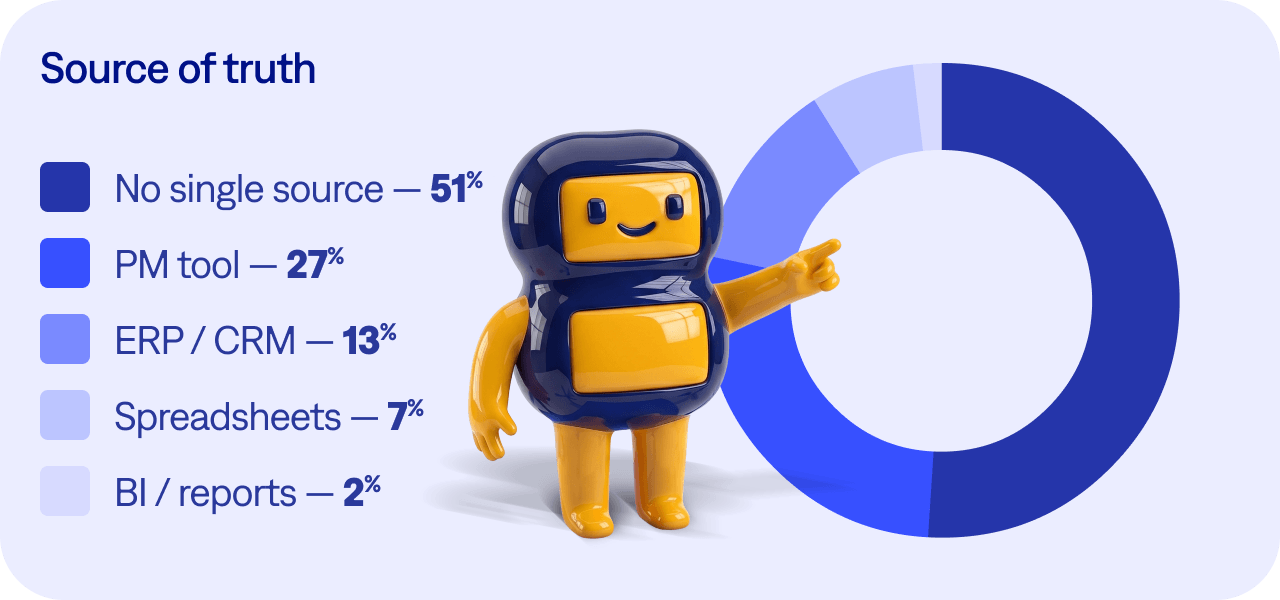
The source of truth in the Easy8 AI adoption survey Q2 2026
Automation is locked behind IT
When we asked who builds and maintains automations, 68% pointed to IT, only 18% said business users do it themselves, and a telling 23% weren't even sure automations existed or simply didn't use them.
The people closest to the friction, the ones who know exactly where work breaks, can't fix it without raising a ticket and waiting. Automation isn't absent from these organisations; it's just out of reach for the people who need it most.
The opposite is needed for governed AI adoption: safe, reusable automation that business teams can run within the guardrails that IT sets once.
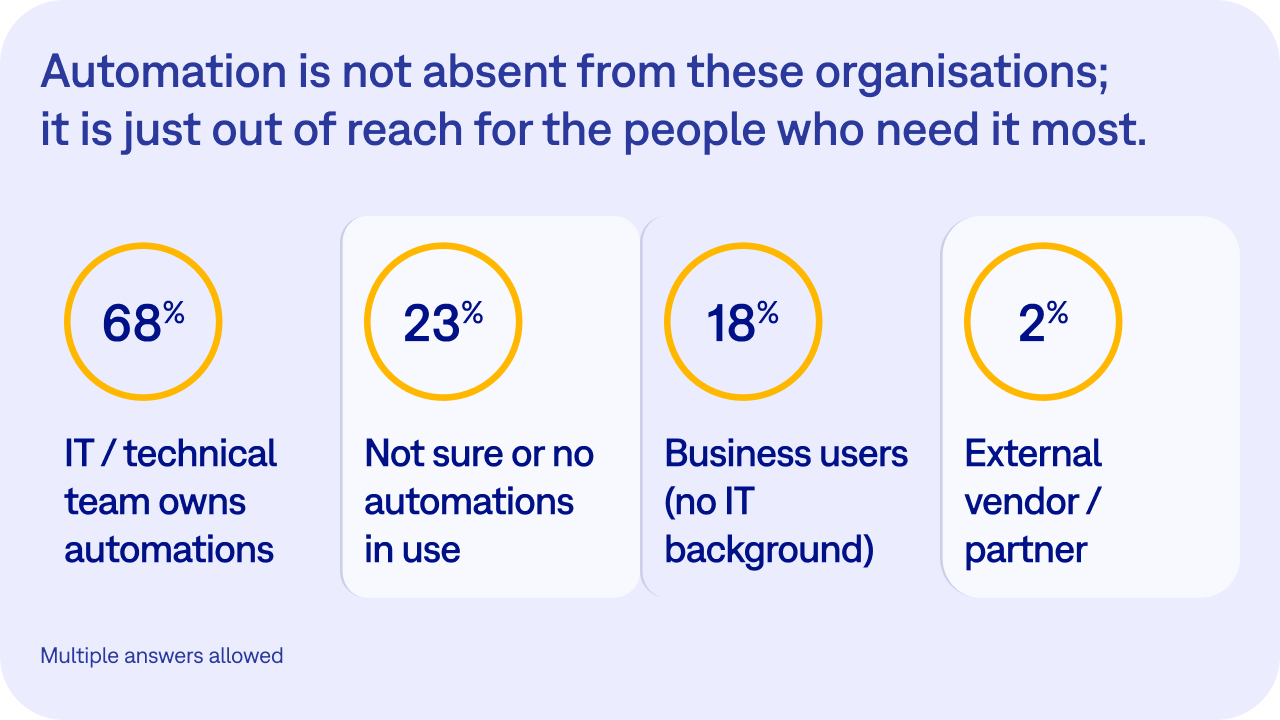
Automation ownership distribution: The Easy8 AI adoption survey Q2 2026
AI governance (un)maturity
Among organisations that use AI, only 19% have approved tools, written policies, and trained people. The other 81% are running the technology faster than they can govern it.
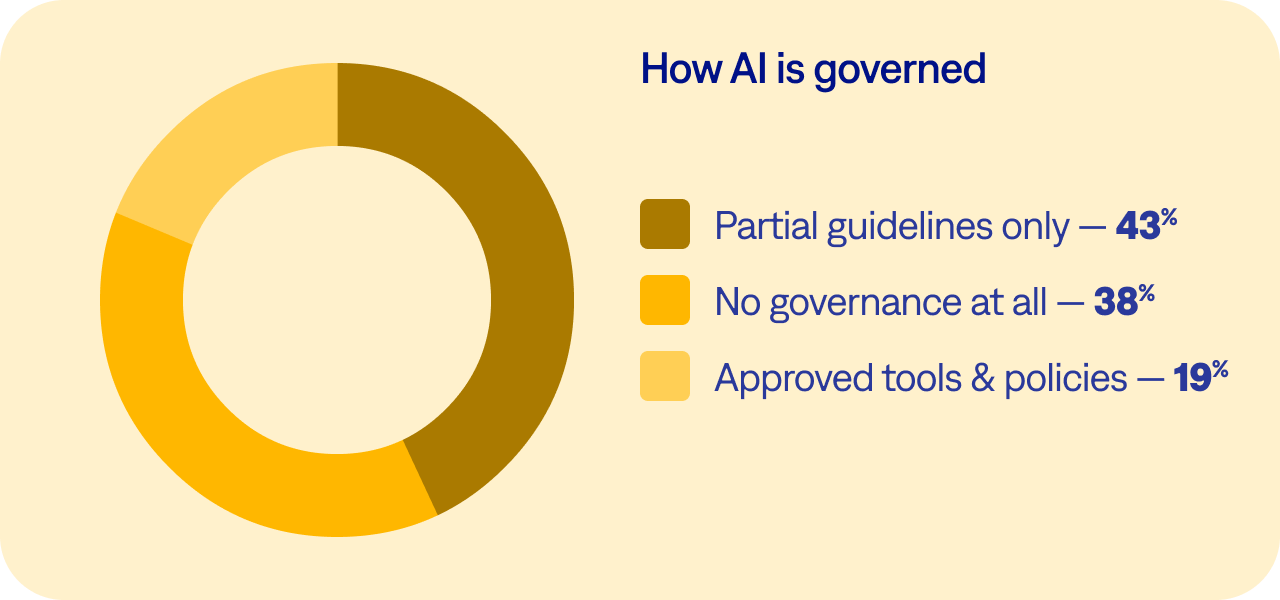
AI governance maturity: The Easy8 AI adoption survey Q2 2026
The AI governance maturity model
We scored each organisation across three dimensions (how work is tracked, how reporting happens, and how AI is governed) into four levels.
Our Q2 2026 AI adoption survey found that 53% of organizations remain at Level 1: Fragmented, with no shared source of truth and AI used individually, while another 32% sit at Level 2: Reactive, relying on a PM tool as reference and basic AI guidelines.
Just 15% reach Level 3: Structured, where data is centralized and AI tools are formally approved, and not a single respondent has reached Level 4: Integrated with real-time unified data and AI-governed workflows.
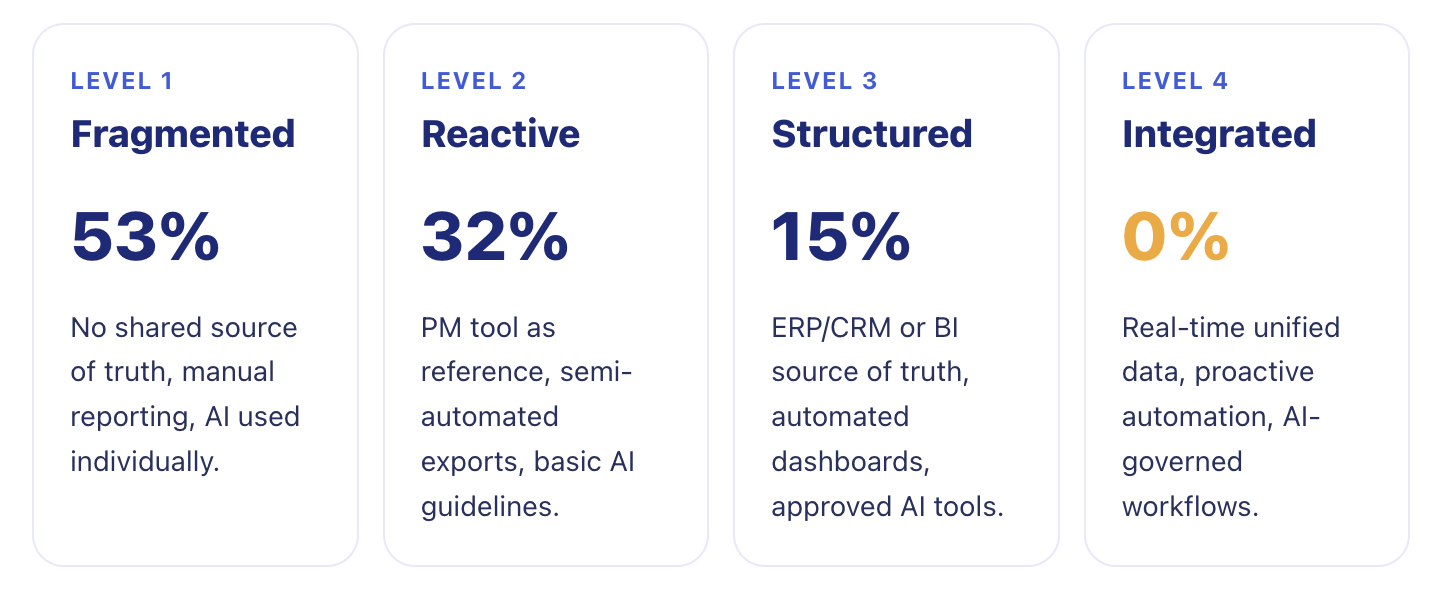
AI maturity levels: The Easy8 AI adoption survey Q2 2026
The takeaway for driving AI in the workplace
The data from our recent survey suggests the problem isn't too much AI; it's AI with no floor under it. You can't govern what you can't see, and you can't feed reliable AI from data that lives in fifty disconnected places.
The way forward is to connect planning, execution, and automation into one governed environment (the WorkOps framework), where approved AI tools operate on a single source of truth, sensitive data stays inside your private cloud or your own servers, and automation is available to the people who actually do the work.
Adopting AI was the easy part. It is the work of building the floor underneath it that separates the 19% of well-governed AI adoptions from the rest.
Download the full report for a deeper look at how organisations are adopting and governing AI, and where the gaps really lie.

Frequently asked questions
What is AI governance?
AI governance is the set of policies, processes, and oversight structures an organization uses to make sure its AI systems are developed and used responsibly, legally, and in line with its own standards. In practice it answers questions like who approves an AI use case, what data it may touch, and who is accountable when it goes wrong.
What are the risks of shadow AI?
The risks of shadow AI cluster into four areas: data leakage (confidential code, customer records, or trade secrets pasted into public tools that may store or train on that input), compliance violations (data handling that was never reviewed, breaching rules like GDPR or HIPAA), unreliable outputs (unverified AI results feeding real decisions), and expanded security exposure (unvetted apps that bypass controls and leave no audit trail).
What is shadow AI?
Shadow AI refers to employees using AI tools like ChatGPT, Copilot, or other generative AI services for work without the knowledge, approval, or oversight of their organization's IT or security teams. The main risks are data leakage, compliance violations, and loss of governance: sensitive company or customer data pasted into unsanctioned tools can be exposed, retained, or used to train external models.
What is WorkOps and how does AI and automation fit into it?
WorkOps connects every stage of business operations — from planning and delivery to reporting and feedback — into a single continuous loop. AI and automation tools sit between each phase, reducing manual handovers and keeping teams working from accurate, up-to-date information.
What is an AI adoption?
AI adoption in companies refers to the strategic process of integrating artificial intelligence technologies into business operations, workflows, and decision-making processes to enhance efficiency, productivity, and innovation.
It involves using AI tools in at least one business function—such as IT, marketing, sales, or customer service—with applications ranging from simple automation workflow to advanced AI systems like machine learning and AI.
The process typically progresses through stages including awareness of AI's potential, experimentation with AI models, integration of AI into existing systems, performance monitoring, and continuous optimization.
Successful AI adoption also requires aligning AI initiatives with business goals, developing staff skills, ensuring data readiness, and establishing governance frameworks for ethical and effective use.
Related articles

Atlassian changes its AI data collection policy
Atlassian has announced changes to how it will use customer metadata and in-app data from 17 August 2026. Alongside this, new in-app settings have been rolling out since 16 April 2026. What could this mean for your organisation? Read on!

The AI adoption curve: Where companies really are in 2026
AI is no longer a futuristic concept. It's a present-day power play reshaping how companies compete, grow, and operate. But while many businesses have jumped on the AI wave, only a few know how to turn potential into performance. Do you know where your organization stands?

Shadow AI: 5 hidden risks and how to fix them
AI is changing how we work, but shadow AI can introduce hidden risks when employees use AI tools without proper oversight. Before adopting AI at scale, discover the risks to sensitive data and how to stay secure, compliant and in control.