Compare Tuleap vs Jira alternatives
With Atlassian Data Center end of life on the horizon, now is the time to explore reliable on-premises alternatives that keep your projects, teams, and data under full control.
Find the best Jira self-hosted alternative!
- On-premises solution from 25+ users
- Confluence alternative, Service Desk and Bitbucket alternative
- Agile tools and Waterfall project management
- Clear pricing
Top Jira Data Center alternatives
As Atlassian retires Data Center support, EOL is getting a real thing; organisations are seeking a self-hosted Jira alternative. Get proper dive-in information to make the right decision for the replacement of the Atlassian Data Center.
|
Atlassian |
Tuleap |
Easy8 |
|
|---|---|---|---|
| Jira Software | |||
| Scrum boards |  |
|
|
| Kanban boards | |
|
|
| Backlog management | |
|
|
| Sprint planning | |
|
|
| Gantt Charts |  |
|
|
| WBS (Mind maps) |  |
|
|
| Resource management | |
|
|
| Agile reporting | |
|
|
| Roadmaps | |
|
|
| Confluence | |||
| Wiki / Knowledge Base | |
|
|
| Page templates | |
|
|
| Rich text editor | |
|
|
| Document versioning | |
|
|
| Full-text search | |
|
|
| Team spaces | |
|
|
| Jira Service Management / Service Desk | |||
| Ticket management | |
|
|
| SLA tracking | |
|
|
| Customer portal | |
|
|
| Email-to-ticket | |
|
|
| Queue management | |
|
|
| Asset management (CMDB) | |
|
|
| Platform and deployment | |||
| On-premises (permanent) | |
|
|
| Cloud deployment | |
|
|
| Git integration | |
|
|
| AI features | |
|
|
| On-premises AI | |
|
|
| GDPR compliance | |
|
|
| ISO 27001 certification | |
|
|


Why consider a Jira on-premises alternative?
The clock is ticking. Atlassian has announced the end of Data Center by 2029 (EOL). This means no more updates, security patches, or support for your self-hosted infrastructure.
On top of that, there are common Jira negatives:
- Complexity: Steep learning curve with overwhelming features that can be difficult for non-technical teams to adopt.
- Closed-source platform: Proprietary software with no open-source option, limiting transparency and community-driven development.
- Forced migration: Atlassian is pushing all users toward cloud-only subscriptions, removing the on-premises option entirely.
- Costs: On-premises Jira Data Center edition or cloud subscriptions are high long-term costs.
Why is Easy8 the #1 on-premises PM alternative over Tuleap & Jira?
Agile & Waterfall project management in one platform
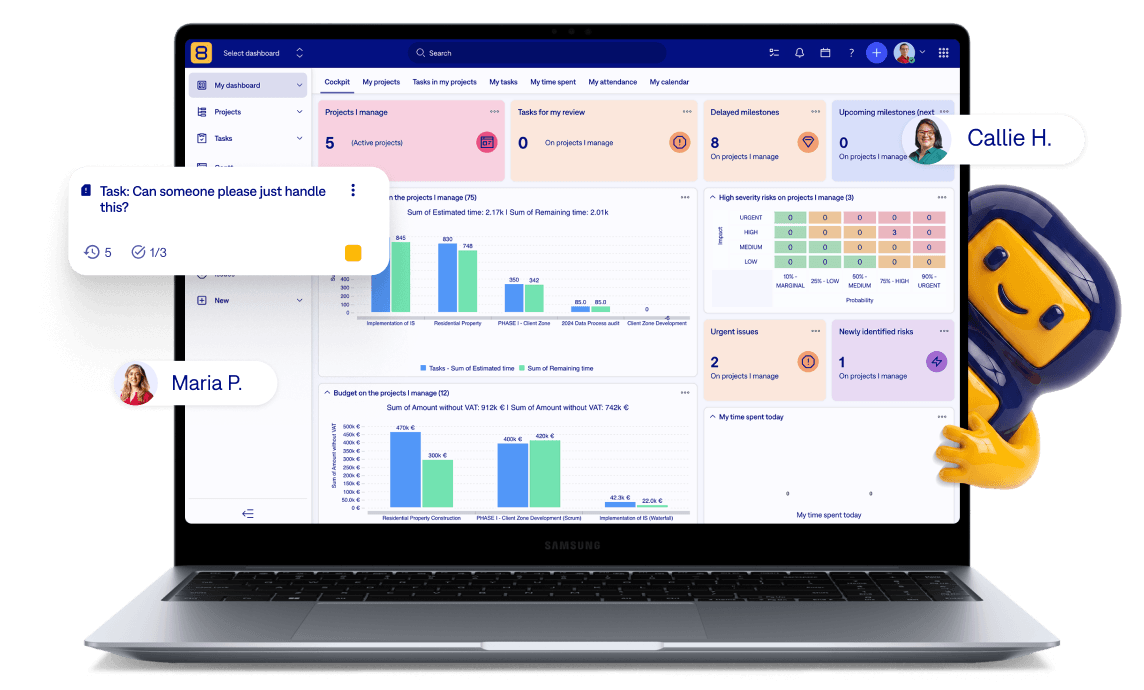
Easy8 Agile project management gives Jira users everything they’re used to—and even more with Waterfall features. Plan and track work on customizable Scrum and Kanban boards, manage backlogs and sprints, and link tasks with time tracking, resources, and reporting in just a few clicks.

Confluence self-hosted alternative
The Knowledge Base is a great alternative to Confluence. It centralises essential project, IT, and service information, making it easy for teams to access, share, and reuse know-how across all project phases, reducing duplication and speeding up issue resolution.

Jira Service Desk alternative
The HelpDesk in Easy8 integrates with project and service management, enabling efficient ticket handling, SLA tracking and faster issue resolution.
This alternative to Jira Service Desk lets users submit tickets via email or an intuitive interface. It sends automatic notifications, monitors SLA performance, and provides complete visibility into your support operations.

Software development with GitLab integration
While Jira integrates with Bitbucket, Easy8, Jira open source alternative, offers native GitLab integration. This brings repositories, merge requests, commits, and releases right into your project interface, giving your team complete visibility into development progress. All self-hosted, migration fully supported.
Setup is simple: name the repo, insert the URL and token, and then choose between automatic or manual syncing. This enables teams to link commit statuses and log time against tasks for better traceability and informed decision-making.

Workflow Automations and AI agents powered by n8n
With n8n integration you can connect Easy Redmine to over 1,000 apps and build no‑code workflows that sync tasks, trigger actions and reduce manual effort.
By embedding AI agents and automation workflows via n8n your team can get real‑time alerts on risks, automatically escalate issues and standardise processes without constant supervision.

How to migrate to Easy8

Choose between the cloud or server deployment. We recommend starting with the Easy8 free trial. Your team can migrate to on-premises at any time.

Our experts will migrate your data from Jira, Confluence, Jira Service Desk and Bitbucket. We replicate your workflows, configurations, and functions to ensure seamless continuity.

See for yourself, side-by-side, that all your projects, issues, and workflows have been accurately transferred and are fully functional in Easy8.
Get Easy8 as on-premises alternative solution
With expert guidance and a structured three‑step process: enumerations migration, interim configuration and customisation, followed by full data import, Easy8 makes switching from Jira far less stressful.
Throughout the migration, you retain full visibility over your users, projects and tasks, and after migration, you run thorough user testing so everything works as expected in the new environment.
Case studies of data migration

Data migration from Jira to Easy8: Case study of Aspecta
System Integrator
Jira handled issue tracking. But Aspecta needed to see the whole picture. Manage resources, budgets, and portfolios in one place. Here's how they made the switch to Easy8.

Data migration from Jira to Easy8: A comprehensive look at Istari Vision
Software Development
In this comprehensive case study, we will take a look at Istari Vision's data migration from Jira Software to Easy8. Learn how Istari Vision took advantage of the opportunities and improved the operational process in an effective way.
Articles and tips on self-hosted project management

End of Jira Server: Find Jira on-premises alternatives
Atlassian is a market leader in the project management software industry, with a wide range of popular tools that are used by millions of people around the world. As a market leader, Atlassian has a strong position in the market and can often dictate the direction that its products take. This can include making changes to its tools that are unpopular with some users, such as moving from a Server model to a cloud-based model.
While moving to a cloud-based model can bring many benefits, it can also be disruptive for organizations that are used to the Server model. This can be especially true not only for larger organizations that have significant investments in on-premises infrastructure and processes but also for anyone with a smaller user base.

Break free from Jira Server: Use on-premises alternative
Atlassian ended support for Jira Software Server in February 2024, cutting off updates, bug fixes, and security patches for self-hosted users. With Jira Data Center now the only on-premises option and not a permanent one, many teams are seeking alternatives built for long-term, secure project delivery on their own terms.

The end of Jira on-premises: Atlassian Data Center terminates support
Atlassian is discontinuing Jira Data Center, and with it, the last on-premises option for Jira users. By 2029, support and updates will be gone entirely. The countdown has started: migrate to the cloud, plan a hybrid setup, or find a true on-premises alternative before the clock runs out. The first phase will be here by the end of March 2026.
Frequently asked questions
Is Atlassian Data Center going away?
Yes, Atlassian Data Center is going away and will reach its end of life on March 28, 2029. At that point, Data Center subscriptions will expire, and environments will become read-only, meaning no new updates, patches, or support will be provided.
This end-of-life applies to major Data Center products like Jira Software, Jira Service Management, Confluence, Bamboo, and Crowd, although Bitbucket Data Center is excluded and has a dual license model allowing cloud and Data Center use.
What is the difference between Atlassian Data Center and Server?
Atlassian Data Center and Server are two distinct self-hosted deployment models for Atlassian products (Jira, Confluence, Bitbucket, and others), each designed for different organizational needs and scales. The fundamental technical difference is that Data Center supports a multi-node cluster architecture while Server operates on a single application server.
While both offer the same core functionality, Data Center is purpose-built for enterprises requiring high availability, performance at scale, and operational flexibility, whereas Server is suited for smaller organizations with more modest deployment requirements.
What is Atlassian Data Center platform?
Atlassian Data Center is a self-managed, enterprise-grade deployment platform for Atlassian products designed to meet the mission-critical needs of large organizations. It represents the evolution of Atlassian's self-hosted offerings following the end of Server support, combining advanced technical architecture with comprehensive enterprise capabilities to deliver high availability, scalability, and operational control.
What are the disadvantages of using Jira?
Jira’s flexibility and depth come with a steep learning curve and significant administrative overhead, as teams must master complex configurations and dedicate resources to ongoing maintenance. Large instances can suffer performance bottlenecks and require disruptive re-indexing, while licensing and add-on costs quickly escalate.
Over-customisation risks process fragmentation and upgrade headaches, and native reporting tools are limited without additional plugins or BI integrations. Finally, the crowded UI and integration complexity can hinder adoption and create data silos if not carefully managed.
What are the key risks of using an unsupported server?
The process involves not only transferring raw data but also cataloging various entities crucial for the PM tool's operation, such as task types and statuses. Optimizing resources, including CPU, RAM, and HDD, is vital for maintaining application performance post-migration. Inadequate resource allocation can lead to decreased performance and productivity.
What is the best Jira alternative?
Many teams seek alternatives due to Jira's complexity, cost, or specific feature needs. Several tools offer compelling options, each with unique strengths suited for different kinds of teams and workflows. Among them is Easy8, which provides open source solutions to 25+ team members.
Organizations considering switching from Jira may find Easy8 particularly appealing due to its hybrid project management capabilities, extensive feature set, greater data control, and lower operational costs—all crucial factors for modern, security-conscious, and cost-sensitive teams.
Is Jira Data Center on-prem?
Yes, Jira Data Center supports on-premises deployment on your own physical hardware, virtual machines, or Kubernetes clusters, offering full control over infrastructure. It enables both single-node and clustered setups with shared home directories via NFS/SAN for high availability across multiple nodes.
However, with its end of life approaching in March 2029 (no renewals after March 2028), it lacks future support, security updates, or new features.
For sustained high-security on-premises needs, Easy8 provides a viable self-hosted alternative with equivalent scalability, encryption, and Jira migration tools. This shift ensures data sovereignty without Atlassian's EOL risks.
What is the difference between Jira Cloud and Jira Data Center?
Jira Cloud is a fully hosted SaaS solution managed by Atlassian, offering automatic scaling, built-in AI features like advanced automation and predictive insights, and zero infrastructure maintenance. Jira Data Center, by contrast, runs on-premises or in your own cloud infrastructure, providing active-active clustering for high availability, extensive customization, and full data control via multi-node setups.
Cloud prioritizes ease of upgrades and rapid feature releases but limits deep customizations, while Data Center excels in performance tuning and compliance for large enterprises yet requires IT overhead.
Note that Data Center faces end of life in March 2029 with no renewals after March 2028, lacking future support.
For secure on-premises continuity, Easy8 offers a self-hosted alternative with comparable scalability, encryption, and Jira migration tools.
What is the difference between Jira Server and Jira Data Center?
Jira Server and Jira Data Center both offered self-hosted deployments, but Server was designed for smaller teams with single-node setups and limited scalability, while Data Center provided enterprise-grade clustering, high availability, and support for thousands of users across multiple nodes.
However, Jira Data Center has reached end of life as of March 2029, with no new licenses or renewals after March 2028, leaving organizations without ongoing Atlassian support or updates.
For teams needing high-level security in a self-hosted environment, Easy8 stands out as a suitable replacement, featuring robust encryption, role-based access controls, GDPR compliance, and seamless Jira data migration for on-premises control.
Can Jira be self-hosted?
Jira can be self-hosted through its Data Center edition, but Atlassian ended support for Jira Server on February 15, 2024, ceasing security updates, bug fixes, and technical support. Data Center, the remaining on-premises option, faces end of life by March 28, 2029, after which it becomes read-only with no new features or renewals past March 30, 2028.
Organizations seeking a self-hosted replacement should consider tools like Easy8, which offers full on-premises deployment with Jira-compatible migration tools, customizable workflows, and ongoing support.