Why European software alternatives are trending in 2026

Table of contents
Data sovereignty goes mainstream
CLOUD Act vs. data sovereignty
The BitLocker backdoor moment
Trump, tariffs, and the sovereignty backlash
The numbers behind EU sovereign cloud
European alternatives to US software
TL;DR
European alternatives are gaining momentum. More than 100 GDPR-compliant alternatives to popular US tools are now available, while initiatives like EuroStack and the EU Open Source Strategy are strengthening the local ecosystem.
Data sovereignty goes mainstream
Gartner expects worldwide sovereign cloud spending to hit $80 billion in 2026, with the EU sovereign cloud market growing 83%. Data sovereignty has moved from the IT department to the boardroom, with legal and political concerns now shaping business decisions alongside technical ones.
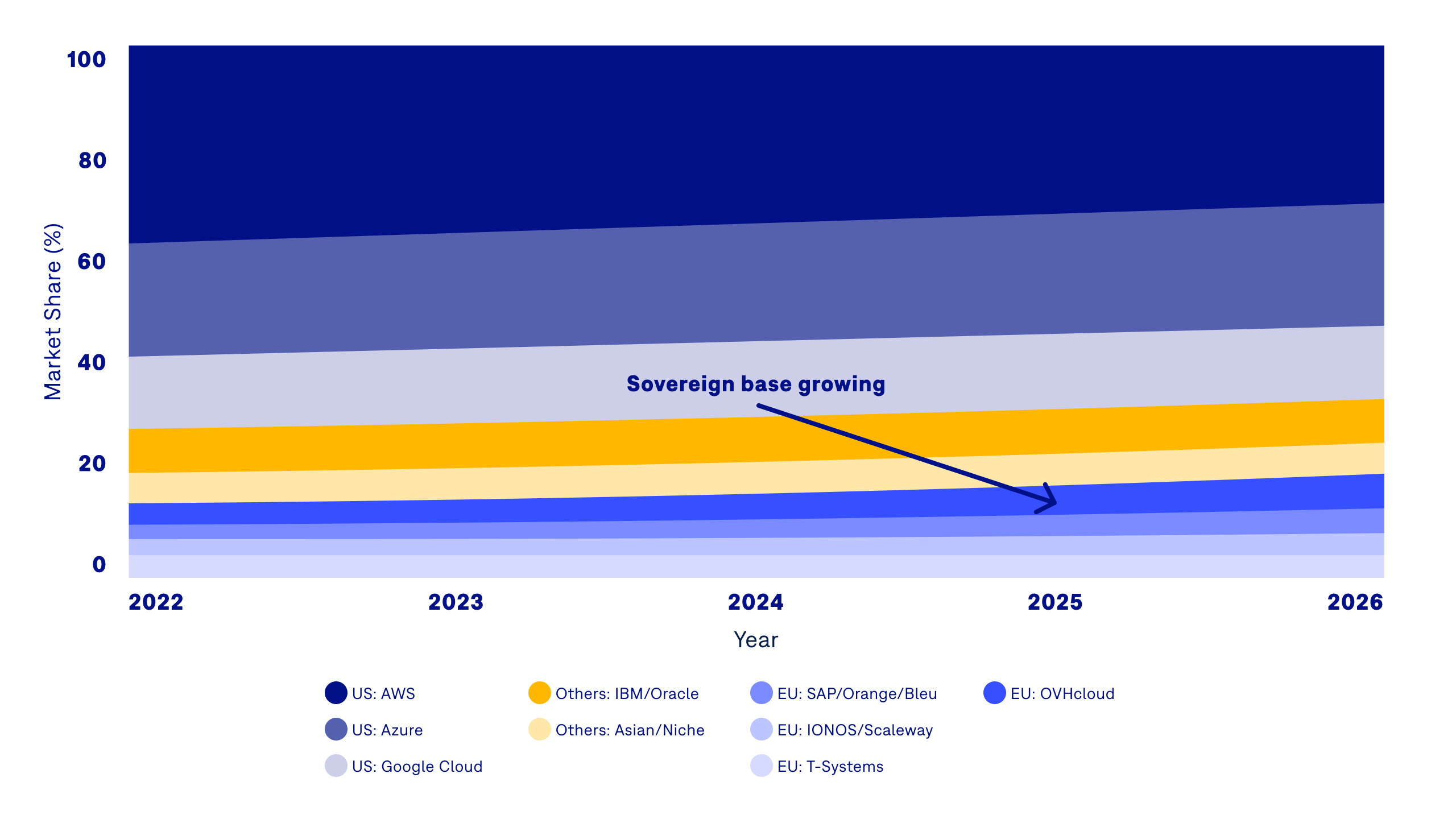
EU sovereign cloud share rising
CLOUD Act vs. data sovereignty
Since 2018, the US CLOUD Act has let US law enforcement compel any US-based company to hand over data it controls, no matter where it’s stored. Even a file in an EU data center is still reachable by a US warrant, because the company operating it is American.
Microsoft has acknowledged that its EU Data Boundary cannot override the US CLOUD Act. In the second half of 2025 alone, the company received 5,587 government data requests. The takeaway is simple: storing data in the EU doesn't automatically protect it from US legal access.
The BitLocker backdoor moment
In January 2026, Forbes and TechCrunch reported that Microsoft had turned over BitLocker recovery keys to the FBI, the first confirmed case of its kind. Microsoft’s own framing is basically that if you hold the keys, law enforcement will eventually ask for them.
Unlike others, Apple says it has never created a backdoor. In 2025, it even chose to remove an encryption feature in the UK rather than compromise its security. That shows why security needs to be built into the product, not guaranteed by policy.
Trump, tariffs, and the sovereignty backlash
Since early 2025, the Trump administration has argued that foreign digital regulations unfairly target US tech companies; by mid-2026 it was threatening 100% tariffs on countries that introduce digital services taxes.
As Foreign Policy reported in July 2026, the pressure has had the opposite effect: it has encouraged the EU, and even Canada, to invest more heavily in homegrown technology and reduce their dependence on US providers.
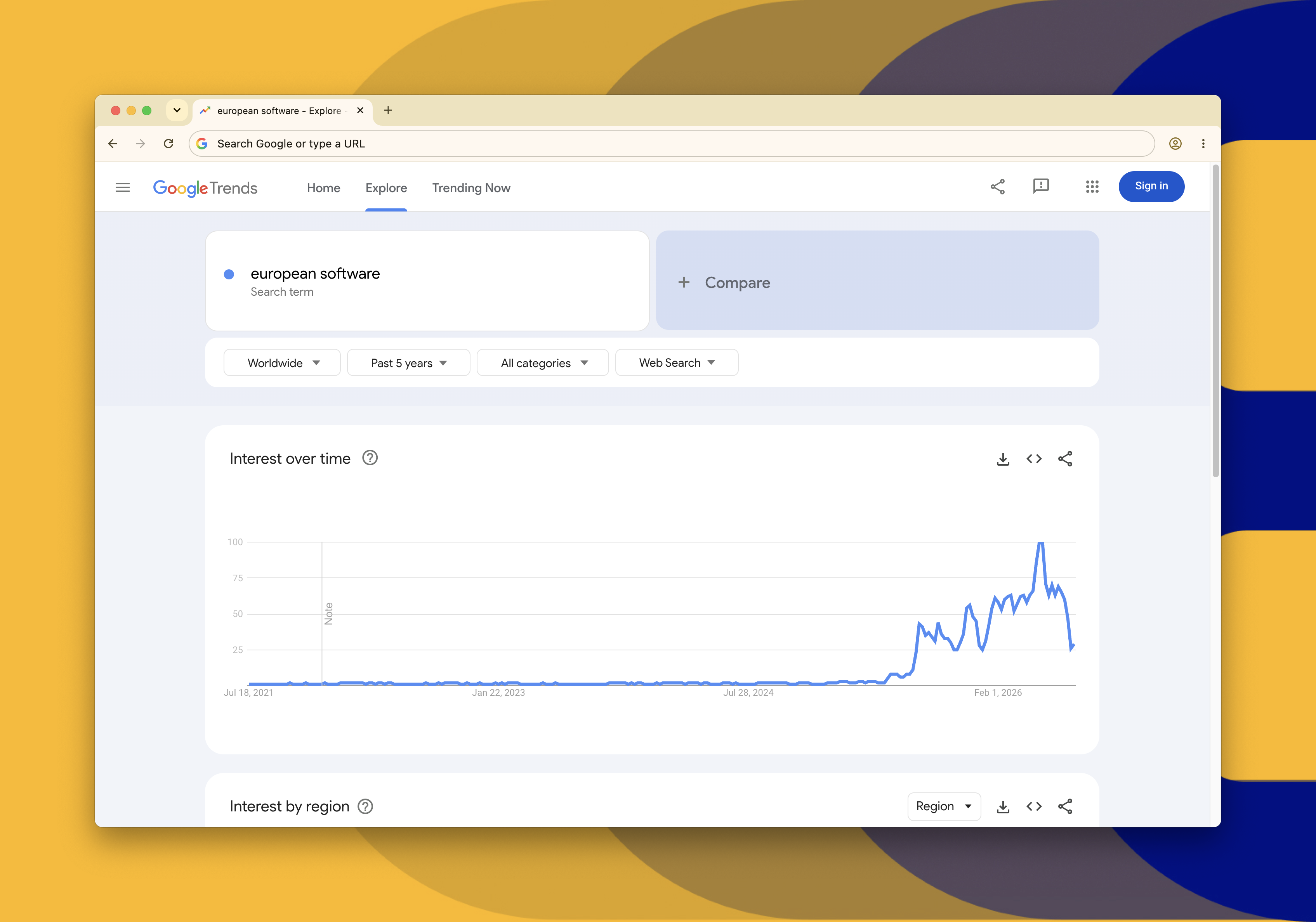
Search volume of the query "European software" from the beginning of 2026
The numbers behind EU sovereign cloud
McKinsey’s 2025 survey of European tech leaders found sovereignty was the top infrastructure priority, ahead of cost or performance, and 44% cited data security as a reason to avoid public cloud.
Even so, European providers still control only about 15% of the market, while AWS, Microsoft, and Google account for roughly 70%. That imbalance is driving initiatives such as EuroStack and the EU Open Source Strategy.
European alternatives to US software
Finding European software is becoming much easier. Directories such as EU Alternative or Reddit community r/Buy_European now list more than 100 GDPR-compliant European alternatives to popular US tools like Jira, HubSpot, and Asana. At the same time, Atlassian's decision to stop selling new Jira Data Center licenses in March 2026 is pushing more organizations to consider self-hosted options.
The trend is only getting stronger. As businesses look for greater control over their data and technology, European software is moving from a niche choice to a strategic one.
Explore EU-built project management software with a self-hosted deployment option! Try Easy8 Private WorkOps Platform, the alternative to the popular US-based Jira, and keep your projects, data, and infrastructure under your control.

Frequently asked questions
Are there any EU cloud providers?
Yes. Major EU-based cloud providers include OVHcloud and Scaleway (France), Hetzner and IONOS (Germany), and UpCloud (Finland), all alternatives to the US hyperscalers for organisations that want data held under EU jurisdiction.
What is the CLOUD Act?
The CLOUD Act is a U.S. federal law that clarifies how law enforcement can access data stored overseas by American tech companies.
Enacted on March 23, 2018, as part of the Consolidated Appropriations Act, it amends the 1986 Stored Communications Act to require U.S.-based providers to disclose data they control—regardless of server location—upon a warrant or subpoena. It also enables bilateral executive agreements with foreign governments, allowing reciprocal data access for serious crimes while imposing safeguards like privacy protections and challenge mechanisms for providers.
What does the CLOUD Act do?
The CLOUD Act, enacted in 2018, amends U.S. law to clarify how law enforcement accesses data stored by U.S. tech companies, regardless of server location.
It compels providers to disclose customer data on U.S. servers or abroad via warrants, while allowing challenges if foreign privacy laws conflict, and enables bilateral agreements with other nations for reciprocal access to combat serious crimes.
What is the European sovereign cloud?
A European sovereign cloud is a cloud-computing environment that keeps all customer data, metadata, workloads and administrative control under exclusive European Union (EU) jurisdiction, operated by EU-based staff and certified against EU rules, so that organisations can comply with the bloc’s demanding privacy, cybersecurity and industrial-policy requirements while still enjoying hyperscale cloud services.
The idea is driven by Europe’s wider push for digital sovereignty—reducing reliance on non-EU tech infrastructure— and is being realised through a mix of EU policy instruments (GDPR, the proposed Cloud & AI Development Act, the EU-wide “EUCS” security label) and large public-private projects.
Due to conflicting legislatures, there is a serious doubt among legal experts whether a US based parent company can truly provide an EU sovereign cloud, as they so strongly claim, through their directly controlled subsidiaries in the EU.
Related articles

Atlassian changes its AI data collection policy
Atlassian has announced changes to how it will use customer metadata and in-app data from 17 August 2026. Alongside this, new in-app settings have been rolling out since 16 April 2026. What could this mean for your organisation? Read on!

Top 5 open source Jira alternatives
Jira’s rising costs, forced cloud shift, and clunky performance are pushing more teams to ask a simple question: isn’t there a better way to run projects? In this guide, we’ll walk through five open-source Jira alternatives that give you predictable pricing, on-premises options, and the flexibility to model complex workflows.

The end of Jira on-premises: Atlassian Data Center terminates support
Atlassian is discontinuing Jira Data Center, and with it, the last on-premises option for Jira users. By 2029, support and updates will be gone entirely. The countdown has started: migrate to the cloud, plan a hybrid setup, or find a true on-premises alternative before the clock runs out. The first phase the ended in March 2026.